Most lists of corrugated box manufacturers in the USA still show WestRock and Smurfit Kappa as two separate companies. They merged in July 2024. International Paper bought DS Smith in early 2025, and Packaging Corporation of America took over the containerboard business of Greif that September. The top of this industry no longer looks the way those lists describe it.
This guide covers the top 10 corrugated box manufacturers in USA as they stand in 2026: who they are, how large they are, what they make, and which kind of buyer each one suits. Every figure comes from a company filing, a press release, or a trade publication, and each one carries its date so you can check it yourself.
One point before the list. The largest manufacturer is rarely the right supplier for a small or mid sized order. Size tells you who fills national grocery and retail programs. It does not tell you who will quote a few hundred printed shipping boxes for a growing brand. That is why each company below is matched to the buyer it actually serves.
The Top 10 Corrugated Box Manufacturers at a Glance
| Rank | Manufacturer | Headquarters | Ownership | Known for | Best suited to |
| 1 | International Paper | Memphis, Tennessee | Public (NYSE: IP) | Largest corrugated packaging producer in North America by capacity | National programs with very high volume |
| 2 | Smurfit Westrock | Dublin, Ireland, with its North American office in Atlanta, Georgia | Public (NYSE: SW) | Corrugated boxes, folding cartons, and retail displays under one roof | Large brands that buy several packaging formats |
| 3 | Packaging Corporation of America | Lake Forest, Illinois | Public (NYSE: PKG) | 10 mills and 90 corrugated plants, with most sales going to regional and local accounts | Regional businesses that want a mill backed supplier |
| 4 | Georgia-Pacific | Atlanta, Georgia | Private, owned by Koch | Containerboard and corrugated packaging for industrial and food customers | High volume industrial and produce packaging |
| 5 | Pratt Industries | Atlanta, Georgia | Private | Boxes made from 100 percent recycled paper | Buyers with recycled content targets |
| 6 | Green Bay Packaging | Green Bay, Wisconsin | Private, family owned | Making boxes since 1933, with about 40 facilities in 16 states | Midwest and Southern buyers who want an integrated, family owned supplier |
| 7 | Menasha Packaging | Neenah, Wisconsin | Private, family owned | Retail displays and high graphics packaging | Consumer brands selling through stores |
| 8 | Hood Container | Atlanta, Georgia | Private | Its own paper mills plus box | Industrial and graphics work in the Southeast and Midwest |
| 9 | Welch Packaging | Elkhart, Indiana | Private, family owned | A network of local box plants across six states | Small and mid sized businesses in the Midwest |
| 10 | SupplyOne | Newtown Square, Pennsylvania | Private equity owned | Largest independent supplier of corrugated packaging in the country | Mid sized manufacturers that want one source for boxes and supplies |
How This List Was Ranked
Ranks 1 to 3 follow production capacity. In January 2026, the TAPPI publication Paper360 reported Fastmarkets capacity figures that place International Paper first, Smurfit Westrock second, and Packaging Corporation of America third among North American producers of containerboard and corrugated packaging.
The first three are ranked by reported North American capacity. For private companies where comparable production data is unavailable, the list uses manufacturing footprint, integration, market presence, and product scope. Georgia-Pacific and Pratt Industries come next. Both are privately held, so neither publishes box volumes, but trade coverage has long described Pratt as the fifth largest corrugated packaging company in the country, which leaves Georgia-Pacific in fourth.
Ranks 6 to 10 are not a strict size order. These companies are private and do not report shipments, so they are placed by footprint (number of plants and states served) and by the range of buyers they can supply.
Three kinds of companies were left out:
- Online print shops and brokers that sell boxes but do not run their own converting equipment
- Companies whose main product is something other than corrugated, such as folding cartons or plastic packaging
- Producers headquartered outside the country, apart from Smurfit Westrock, whose largest business is its North American one
What Has Changed Since the Older Lists
Four deals reshaped the list of the largest corrugated box manufacturers in USA, and most published rankings have not caught up.
| Date | What happened |
| July 2022 | Menasha Packaging bought the high graphics packaging unit of Georgia-Pacific |
| July 5, 2024 | WestRock merged with Smurfit Kappa to form Smurfit Westrock |
| Early 2025 | International Paper acquired DS Smith at an enterprise value of about 9.9 billion dollars |
| September 2, 2025 | Packaging Corporation of America completed its 1.8 billion dollar purchase of the Greif containerboard business, which added two mills and eight sheet feeder and corrugated plants |
One more change is still in progress. On January 29, 2026, International Paper announced a plan to split into two public companies. The North American business, including the former DS Smith plants in the region, will keep the International Paper name.
Lists that still treat WestRock, Smurfit Kappa, DS Smith, or Greif’s former containerboard business as separate current manufacturers need to be updated.
The US Corrugated Box Industry in Numbers
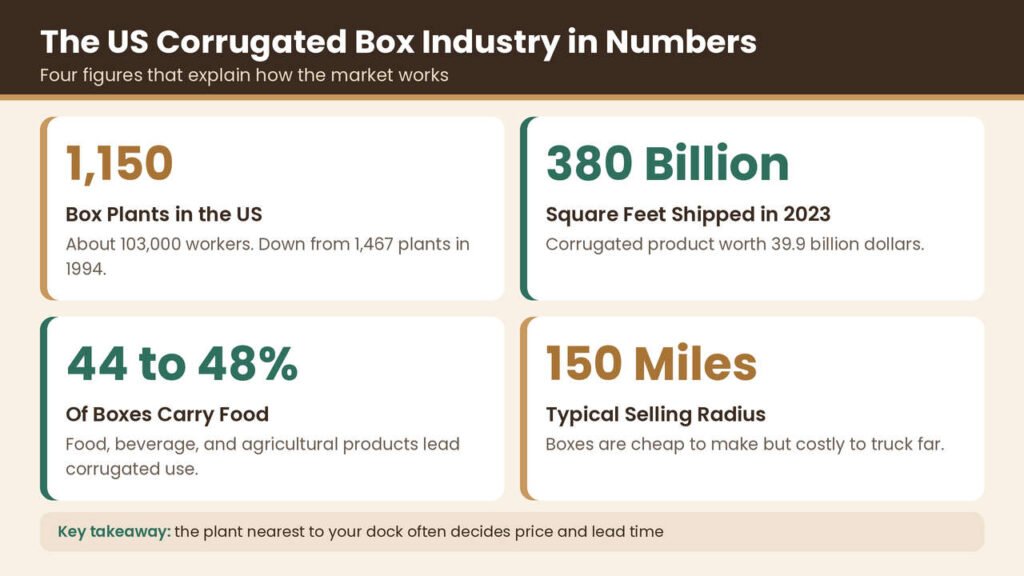
- About 1,150 box plants operate in the United States, employing roughly 103,000 people, according to Bureau of Labor Statistics data published by the Association of Independent Corrugated Converters in October 2024. In 1994 the count was 1,467 plants.
- 380 billion square feet of corrugated product shipped in 2023, worth 39.9 billion dollars, based on Fibre Box Association data.
- Close to half of all boxes carry food. Fibre Box Association figures quoted in Packaging Corporation of America annual reports put food, beverage, and agricultural products at 44 to 48 percent of corrugated use in recent years.
- 150 miles. Corrugated producers generally sell within a 150 mile radius of their plants, as Packaging Corporation of America states in its annual report. Boxes are bulky and cheap to make but costly to truck.
That last number matters more than any ranking. When you compare corrugated box suppliers, the plant nearest to your dock often decides price and lead time more than the name on the building.
Profiles of the Top Corrugated Box Manufacturers in USA
Two terms come up in almost every profile. An integrated producer owns the paper mills that make containerboard as well as the plants that turn it into boxes. A sheet plant buys ready made corrugated sheets and converts them into finished boxes, which is how most short custom runs get made.
1. International Paper
Headquarters: Memphis, Tennessee. Ownership: public, NYSE: IP. Type: integrated producer.
International Paper is the largest producer of containerboard and corrugated packaging in North America by capacity, based on the Fastmarkets figures reported by Paper360 in January 2026. Net sales reached 23.63 billion dollars in 2025, a 49 percent jump that came from adding DS Smith. Its boxes go mainly to ecommerce, food and beverage, and industrial manufacturing customers.
The company is in the middle of a rebuild. In 2025 it closed its containerboard mills in Savannah and Riceboro, Georgia, which removed about one million tons of annual capacity. It is spending 250 million dollars to convert a machine at its Riverdale mill in Selma, Alabama to containerboard. It is also building a 225 million dollar, 468,000 square foot box plant in Brandon, Mississippi, with production due to start in the fourth quarter of 2027. The cuts have not hurt demand. North American box volumes rose 1.7 percent year over year in the second quarter of 2026.
Best for: national brands and large manufacturers that ship from many locations and need the same box specification at every one of them.
2. Smurfit Westrock
Headquarters: Dublin, Ireland, with the North American business run from Atlanta, Georgia. Ownership: public, NYSE: SW. Type: integrated producer.
Smurfit Westrock was formed on July 5, 2024, when Smurfit Kappa merged with WestRock. Its annual report for 2024 lists operations in 40 countries, 62 paper mills, and 459 converting plants, of which 306 make corrugated containers. North America brings in the majority of its revenue.
What separates it from the other large producers is range. Besides corrugated shipping boxes, it makes folding cartons such as tuck boxes, along with paper sacks, bag in box packaging, and point of sale displays, so a consumer brand can buy the shipper, the retail carton, and the store display from one supplier.
Buyers should know that the company is trimming its plant network. Management told investors in mid 2026 that the number of box plants in North America running at a recurring loss had fallen from about 80 at the time of the merger to about 20, and that eight converting facilities across Europe and North America were being closed. One of them, the plant in Wakefield, Massachusetts, shut in May 2026. North American corrugated volumes fell 4.8 percent in the second quarter of 2026 because the company chose to walk away from low margin business.If you are a small account, ask which plant will run your order and whether that plant is part of the review.
Best for: large consumer goods companies that want corrugated boxes, cartons, and displays under one contract.
3. Packaging Corporation of America
Headquarters: Lake Forest, Illinois. Ownership: public, NYSE: PKG. Founded: 1959. Type: integrated producer.
Packaging Corporation of America, usually shortened to PCA, runs 10 mills and 90 corrugated products plants and related facilities, according to its second quarter 2026 results. That footprint grew on September 2, 2025, when PCA paid 1.8 billion dollars for the containerboard business of Greif. The deal added mills in Massillon, Ohio and Gladstone, Virginia, plus eight sheet feeder and corrugated plants.
Of the three largest manufacturers, PCA is the one a regional business has the best chance of working with. Its annual report for 2025 says the company sells to about 12,000 customers in roughly 27,000 locations, that about 70 percent of corrugated sales go to regional and local accounts, and that no single customer makes up more than 10 percent of segment sales. Each plant sells to the businesses around it instead of waiting on a few national contracts. In the second quarter of 2026, PCA reported the highest quarterly corrugated shipments in the history of its legacy plants. It makes corrugated shipping boxes and retail merchandise displays.
Best for: regional manufacturers, food processors, and distributors that want a mill backed supplier with a plant nearby.
4. Georgia-Pacific
Headquarters: Atlanta, Georgia. Ownership: private, part of Koch. Type: integrated producer.
Georgia-Pacific is a household name for tissue and paper towels, but it is also one of the largest packaging companies in the USA for containerboard and corrugated boxes. Across all of its businesses it employs about 30,000 people at more than 150 facilities. Its containerboard mills are in Brewton, Alabama; Palatka, Florida; Monticello, Mississippi; Toledo, Oregon; and Big Island, Virginia. Because the company is private, it does not publish a current count of its box plants or its shipment volume. That is why this guide places it by reputation and mill base instead of by a hard number.
Two recent moves show where it is heading. In July 2022 it sold Color-Box, its high graphics packaging unit, to Menasha Packaging. In 2025 it closed its containerboard mill in Cedar Springs, Georgia, a decision that affected about 535 jobs. Both point to a company concentrating on standard corrugated packaging at volume and leaving specialty printed work to others.
Best for: industrial and food companies that buy plain or simply printed shipping containers by the truckload.
5. Pratt Industries
Headquarters: Atlanta, Georgia. Ownership: private. Type: integrated producer, recycled paper only.
Pratt Industries is the largest privately held 100 percent recycled paper and packaging company in America. Board Converting News reported in June 2026 that it operates 6 paper mills, 21 corrugating plants, and 19 recycling facilities across North America.
Those three numbers describe a closed loop, the same idea behind PCR packaging. Pratt collects old corrugated containers and mixed paper through its own recycling operations, turns that material into containerboard at its own mills, and converts the board into new boxes at its own plants. No other company in the top five builds its entire supply on recycled fiber.
It is still expanding. A 496,000 square foot box plant in Warner Robins, Georgia was announced in 2023 at an investment of more than 120 million dollars, and in 2026 the company announced an expansion of its Rockwall, Texas plant that includes a new corrugator line. Smaller buyers have a route in as well. In 2019 Pratt launched Brandable Box, a venture that sells custom printed corrugated boxes to ecommerce companies.
Best for: brands with recycled content targets, and ecommerce sellers that want printed boxes made from recycled board.
6. Green Bay Packaging
Headquarters: Green Bay, Wisconsin. Ownership: private, third generation family owned. Founded: 1933. Type: integrated producer.
George F. Kress started the Green Bay Box Company in 1933 to make corrugated shipping containers. The business is still owned by his family and now runs about 40 facilities in 16 states with more than 4,600 employees.
For its size, Green Bay Packaging is unusually self sufficient. It owns timberlands, recycled and virgin containerboard mills, corrugated container plants, a folding carton facility, and a pressure sensitive label stock business. It was recycling long before the word was common: the company began collecting old corrugated containers to make new paper in 1957.
Recent investment has gone into two large box plants, one in Tulsa, Oklahoma that opened in 2021 and one in Fort Worth, Texas that opened in 2023. On the product side, the company has pushed into retail ready packaging, also called shelf ready packaging, as well as ecommerce packaging, displays, and digital printing.
Best for: mid sized and large companies in the Midwest and South Central states that want an integrated supplier without dealing with a public corporation.
7. Menasha Packaging
Headquarters: Neenah, Wisconsin. Ownership: private, family owned. Type: independent converter with a retail focus.
Menasha Packaging belongs to Menasha Corporation, a family business founded in 1849 that opened its first corrugated box plant in 1927. The parent company reports about 7,500 employees at 112 facilities in North America and Europe.
Menasha does not compete on plain brown boxes. It describes itself as the largest independent retail focused packaging and merchandising provider in North America, and it designs, prints, and fills displays and high graphics packaging for more than 1,800 brands. A 2024 profile by the Association of Independent Corrugated Converters counted nine corrugated printing and converting sites and 32 packaging service sites, supported by litho printing plants in Neenah and in York, Pennsylvania.Its 2022 purchase of Color-Box from Georgia-Pacific added high graphics plants in Richmond, Indiana; Pelahatchie, Mississippi; and Madera, California.
Best for: consumer brands that sell through retail chains and need printed displays, club store packs, and the assembly work that goes with them.
8. Hood Container
Headquarters: Atlanta, Georgia. Ownership: private, a subsidiary of Hood Companies. Type: integrated producer.
Hood Container makes its own paper at mills in New Johnsonville, Tennessee and St. Francisville, Louisiana, and converts it into corrugated boxes, high graphics displays, and contract packaging. As of January 2024 the company had locations in 17 states.
It has grown by buying established regional box makers. Three deals in under two years show the pattern:
- August 2022: Kentwood Packaging in Walker, Michigan
- July 2023: the corrugated business of Sustainable Printing in Dalton, Georgia, which added digital printing capacity
- January 2024: Sumter Packaging in Sumter, South Carolina, including its work in Statesville, North Carolina, which added high graphics packaging
Hood is far smaller than the first five names on this list, and for many buyers that is the appeal. It has a mill behind every order, yet it is small enough that a mid-sized account is not lost among national contracts.
Best for: industrial and consumer goods companies in the Southeast and Midwest that need both shipping boxes and printed display work.
9. Welch Packaging
Headquarters: Elkhart, Indiana. Ownership: private, family owned. Founded: 1985. Type: network of sheet plants with its own sheet feeder.
Scott Welch started the company on April 15, 1985 as Elkhart Container, with four people and basic box making equipment in a 25,000 square foot building. By 2023 Welch Packaging had grown to 18 businesses in six states with more than 1,300 associates. It is now moving beyond the Midwest and Midsouth into the Mid Atlantic.
The model is local. Each plant is set up to make custom corrugated boxes for the businesses in its own market, and the plants draw their corrugated sheets from a sheet feeder that Welch built in Elkhart in 2016. Owning that step gives the network more control over supply than a typical independent sheet plant has.Growth has come largely through acquisitions, including Excel Display and Packaging in Aurora, Illinois in 2020 and Michcor Container in 2024. Alongside industrial boxes, the company offers retail ready packaging, digital print, and assembly and fulfillment.
Best for: small and mid sized businesses in the Midwest that want custom boxes from a plant close enough to visit.
10. SupplyOne
Headquarters: Newtown Square, Pennsylvania. Ownership: private equity, a portfolio company of Wellspring Capital Management. Founded: 1998. Type: independent manufacturer and distributor.
SupplyOne describes itself as the largest independent supplier of corrugated and other value added packaging products, equipment, and services in the country. It was built by acquiring family owned specialty corrugated manufacturers and packaging distributors, and in January 2024 it made its first purchase outside the country with Crownhill Packaging of Toronto.It manufactures corrugated packaging at its own plants, but it also distributes packaging supplies and equipment made by others, and it sells thermoformed plastic, foam, and labels. For a buyer, that mix is the reason to call them: one supplier can cover boxes, protective packaging, tape, and the machines on the packing line.
Best for: mid sized manufacturers, food processors, and medical companies that want to buy all of their packaging from a single source.
Corrugated Box Companies in USA Compared Side by Side
| Manufacturer | Owns paper mills | Latest published scale | Specialty |
| International Paper | Yes | 23.63 billion dollars in net sales for 2025, including its European business | High volume corrugated packaging |
| Smurfit Westrock | Yes | 62 mills and 306 corrugated converting plants worldwide (annual report for 2024) | Boxes, cartons, and displays together |
| Packaging Corporation of America | Yes | 10 mills and 90 corrugated plants (July 2026) | Regional and local accounts |
| Georgia-Pacific | Yes | Five containerboard mills; box plant count not published | Standard corrugated at volume |
| Pratt Industries | Yes, recycled only | 6 mills, 21 corrugating plants, 19 recycling facilities (June 2026) | 100 percent recycled boxes |
| Green Bay Packaging | Yes | About 40 facilities in 16 states | Integrated family owned supply |
| Menasha Packaging | No | 9 corrugated converting sites and 32 packaging service sites (2024) | Retail displays and high graphics |
| Hood Container | Yes | 2 mills, locations in 17 states (January 2024) | Industrial boxes and graphics |
| Welch Packaging | No, but owns a sheet feeder | 18 businesses in six states (2023) | Local custom box plants |
| SupplyOne | No | Not published | Boxes plus packaging supplies |
Which Corrugated Box Manufacturers Take Small Custom Orders?
Welch Packaging, SupplyOne, and the Brandable Box venture of Pratt Industries are the names on this list most open to small custom orders. Individual plants of Packaging Corporation of America and Green Bay Packaging also quote smaller regional accounts.
None of the ten publishes a single national minimum order quantity. Minimums and lead time are set plant by plant, and they depend on board grade, box style, and how the box is printed. A plain regular slotted container in a stock board grade is far easier to place in small numbers than a die cut corrugated mailer box with full color print. The four largest producers are built around truckload programs. A request for a few hundred boxes will usually be referred to a sheet plant or a distributor.
That referral is not a brush off. Many of the companies that advertise custom corrugated boxes or wholesale corrugated boxes online in low quantities are sheet plants and print converters. They buy corrugated sheets from the integrated producers above and do the cutting, printing, and gluing themselves. For anyone buying custom packaging for small businesses, the best corrugated box manufacturers are often these converters, working with board that came from one of the ten companies on this list.
How to Choose a Corrugated Box Manufacturer
Choose by order size and distance first, then by board grade and print method. The company name comes last. These six checks cover most buying decisions.
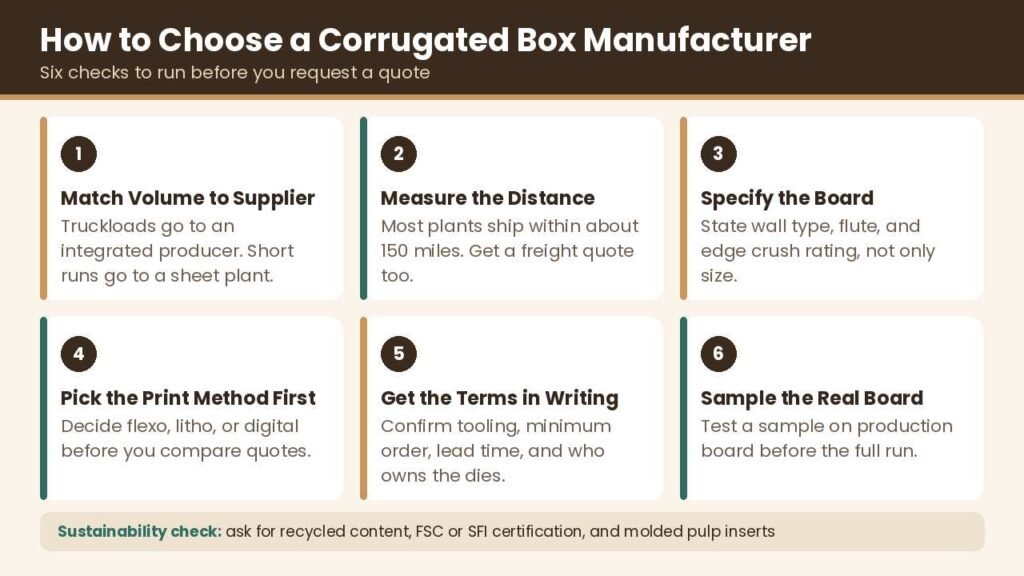
- Match your volume to the supplier type. Truckload programs belong with an integrated producer. Orders of a few hundred to a few thousand boxes belong with a sheet plant or converter.
- Measure the distance. Corrugated producers generally sell within about 150 miles of a plant. Ask which plant will make your boxes, and get a freight quote along with the box price.
- Specify the board, not only the size. State the wall type, flute, and edge crush rating you need. Two boxes with the same dimensions can differ widely in strength and price.
- Pick the print method before you ask for quotes. A supplier set up for one color flexo printing will not be competitive on a full color retail box, and the reverse is also true.
- Get tooling, minimum order quantity, and lead time in writing. Cutting dies and printing plates are usually one time charges. Ask who owns them after you pay.
- Ask for a sample made from the actual board. A plain white prototype shows fit. Only the production board shows how the box stacks and survives shipping.
Buyers with sustainability targets should also ask for the recycled content of the board, for chain of custody certification such as FSC or SFI, and whether the inserts can be molded pulp packaging instead of foam.
Corrugated Board Types: Wall Construction and Flutes
Corrugated board comes in three wall constructions, and the right one depends on the weight of the product and how high the boxes will be stacked.
| Wall type | How it is built | Typical use |
| Single wall | One fluted layer between two flat liners | Most shipping cartons, mailer boxes, and retail packaging |
| Double wall | Two fluted layers and three liners | Heavy products, long distance freight, tall pallet stacks |
| Triple wall | Three fluted layers and four liners | Bulk bins and industrial parts, often in place of wooden crates |
The flute is the wavy layer inside the board. Its size controls cushioning, stacking strength, and how well the surface takes print.
| Flute | Approximate thickness | What it is good at |
| A | 0.19 inch | Cushioning for fragile items |
| C | 0.16 inch | General shipping boxes; the most common flute |
| B | 0.13 inch | Die cut boxes, canned goods, counter displays |
| E | 0.06 inch | Mailer boxes and retail packaging with fine print |
| F | 0.03 inch | Small retail cartons that would otherwise be paperboard |
Double wall board usually pairs two flutes, most often B and C, to combine a smooth print surface with stacking strength.
How Corrugated Boxes Are Printed
Corrugated boxes are printed in one of three ways, and the choice affects price more than any other decision after board grade.
| Method | How it works | Best fit | Trade off |
| Flexo printing | Flexible plates print ink directly on the board | Logos, text, and handling marks in one to four colors on long runs | Plates cost money up front, and fine photographic detail is limited |
| Litho lamination | A sheet printed on an offset press is glued to the corrugated board | Photo quality retail boxes and displays | Highest setup cost, so it suits mid sized and long runs |
| Digital printing | Inkjet heads print straight from an artwork file | Short runs, test launches, and many versions of one box | No plates, but the cost per box stays high at large volume |
For a first order under a few thousand boxes, digital printing is usually the cheapest route because there are no plates to buy. Past that point, flexo printing almost always wins on unit cost.
How Much Does a Corrugated Box Cost in 2026?
IBISWorld puts the 2026 benchmark market price for a corrugated box in the United States at 3.33 dollars. That figure is an average across every size and style, so treat it as a reference point and not a quote. A small plain shipping carton bought by the truckload costs well under it. A large double wall box or a full color printed mailer in a short run costs well over it.
Five things move the price of any corrugated box:
- Board: wall type, flute, and paper weight set the material cost, which is the largest part of the price
- Size: boxes are priced on the square footage of board they use, including the flaps
- Style: a regular slotted container is the cheapest to make, while a die cut box adds a cutting die and more waste
- Print: each added color, and any move from flexo to litho lamination, raises the cost
- Quantity and freight: setup is spread over the run, and trucking a bulky product adds up quickly over distance
Prices are also rising this year. Packaging Dive reported on September 18, 2026 that containerboard producers had announced three rounds of increases since January, and that linerboard would rise 240 dollars per ton in seven months if all of them took hold. The same report linked the increases to mill closures in 2025 that removed about 10 percent of industry capacity. Paper is the main input for every box plant, so higher containerboard prices reach box buyers within a few months.
If you are working out your custom packaging cost for 2027, ask your supplier how much of the 2026 increases are already in the price.
Key Takeaways
- International Paper, Smurfit Westrock, and Packaging Corporation of America are the three largest corrugated box manufacturers in USA by capacity, and all three changed shape through mergers between 2024 and 2025.
- Size does not equal fit. The top four producers are built for truckload programs, while Welch Packaging, SupplyOne, and local sheet plants handle most small custom work.
- Distance matters as much as brand, because corrugated boxes rarely travel more than about 150 miles from the plant that made them.
- Board grade and print method decide the price. Settle both before you compare quotes, and expect 2026 containerboard increases to show up in box prices.
Frequently Asked Questions
Who is the largest corrugated box manufacturer in the USA?
International Paper is the largest. An investor presentation at the 2024 Sohn San Francisco conference estimated its share of the American box market at roughly 30 percent, about 50 percent more than the second largest producer. That was before the DS Smith acquisition and before WestRock merged into Smurfit Westrock, which narrowed the gap.
What is the difference between cardboard and corrugated boxes?
Cardboard is a loose everyday word for any stiff paper based material. Corrugated board is a specific product with a fluted layer glued between flat liners, which gives it far more strength than a single sheet. A cereal box is a paperboard. The brown shipping carton it arrives in is corrugated.
What does ECT 32 mean on a corrugated box?
ECT 32 means the board has an edge-crush rating of 32 lb/in. A standard ECT-32 single-wall box can carry a 65-lb gross-weight limit when certified under the applicable box-maker requirements; the actual box certificate should be checked for its size and weight limits.
What is the cheapest style of corrugated box?
The regular slotted container is the cheapest. It is cut from one rectangular sheet with almost no waste, it needs no custom cutting die, and it runs on standard equipment at high speed. Its four flaps on top and bottom are all the same length, and the outer flaps meet in the middle.
What is the difference between a box plant, a sheet plant, and a sheet feeder?
A box plant has a corrugator, so it makes its own corrugated board from rolls of paper and converts it into boxes. A sheet plant has no corrugator and buys finished sheets to convert. A sheet feeder runs a corrugator but sells the sheets to sheet plants instead of making boxes.
Are the largest corrugated box manufacturers American owned?
Most are, with two exceptions worth knowing. Smurfit Westrock has its global headquarters in Dublin, Ireland, although North America is its largest region. Pratt Industries is run from Atlanta but is the American sister company of Visy, the Australian paper and packaging business led by Anthony Pratt. International Paper, Packaging Corporation of America, Georgia-Pacific, Green Bay Packaging, and Menasha are American companies.
Are corrugated boxes recyclable?
Yes. Corrugated boxes are the most recycled packaging material in the country, and uncoated board also counts as biodegradable packaging. The American Forest and Paper Association reported a cardboard recycling rate of 69 to 74 percent for 2024. Boxes coated with wax or heavily soiled with food are the main exceptions, since many mills cannot process them. .
Is demand for corrugated boxes growing in the USA?
By volume, barely. Fibre Box Association data shows shipments of 374.8 billion square feet in 1994 and 380 billion in 2023, a rise of about 1 percent in three decades. By value the market is growing: Towards Packaging estimates the American corrugated packaging market at 61.19 billion dollars in 2025 and projects 91.46 billion dollars by 2035.