Choosing the right packaging starts with three measurements: length, width, and height. These dimensions determine whether a product fits inside a box, how much space it occupies, and how its size affects shipping and storage.
However, many people confuse length with width, measure the outside instead of the inside, or record dimensions in the wrong order. Even a small mistake can lead to poorly fitting packaging.
This guide explains length width height dimensions, the correct L × W × H order, how to measure a box, and how to calculate its volume and dimensional weight using practical examples.
What Does L × W × H Mean?
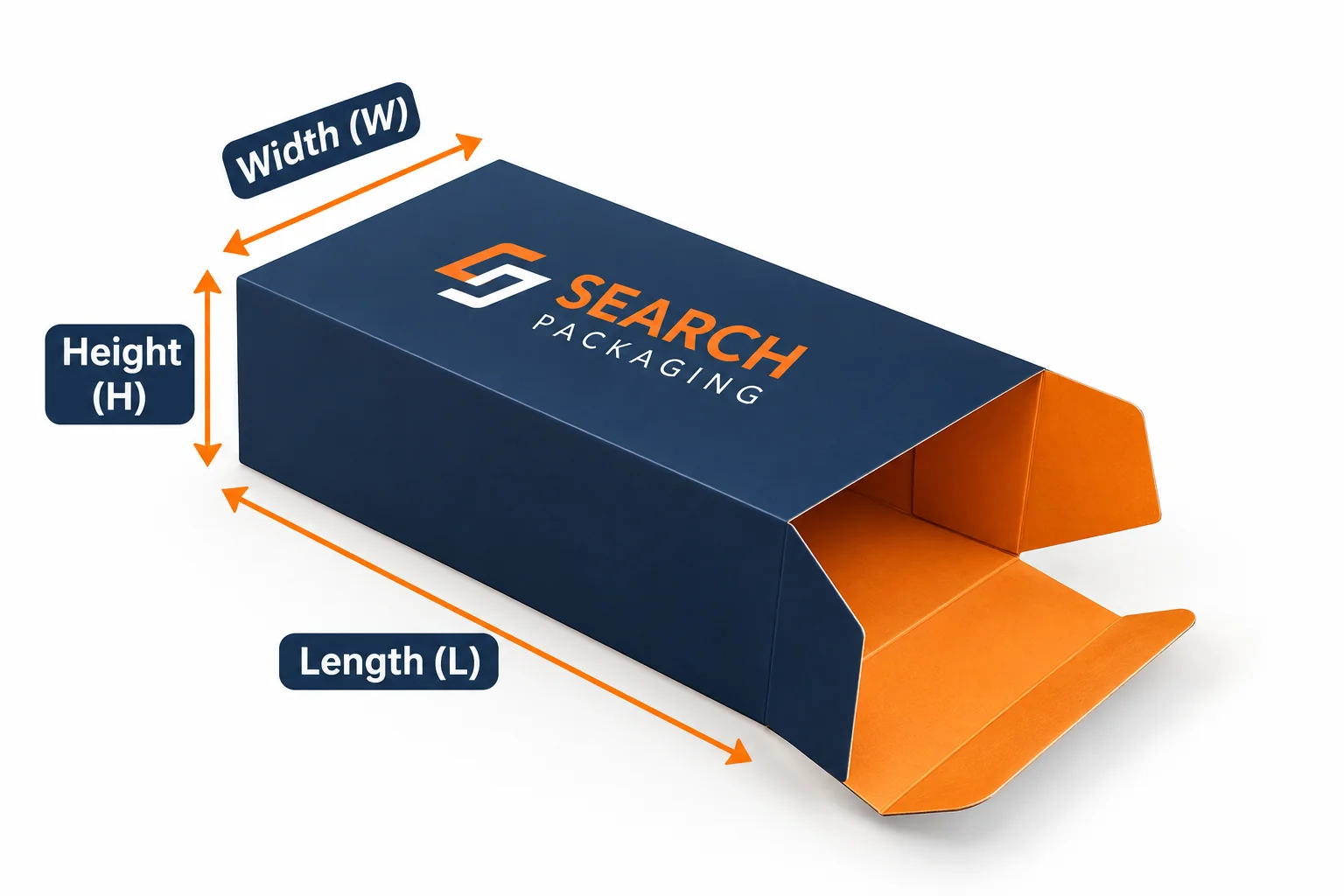
L × W × H stands for Length × Width × Height. It is a common format for describing the three dimensions of a rectangular box.
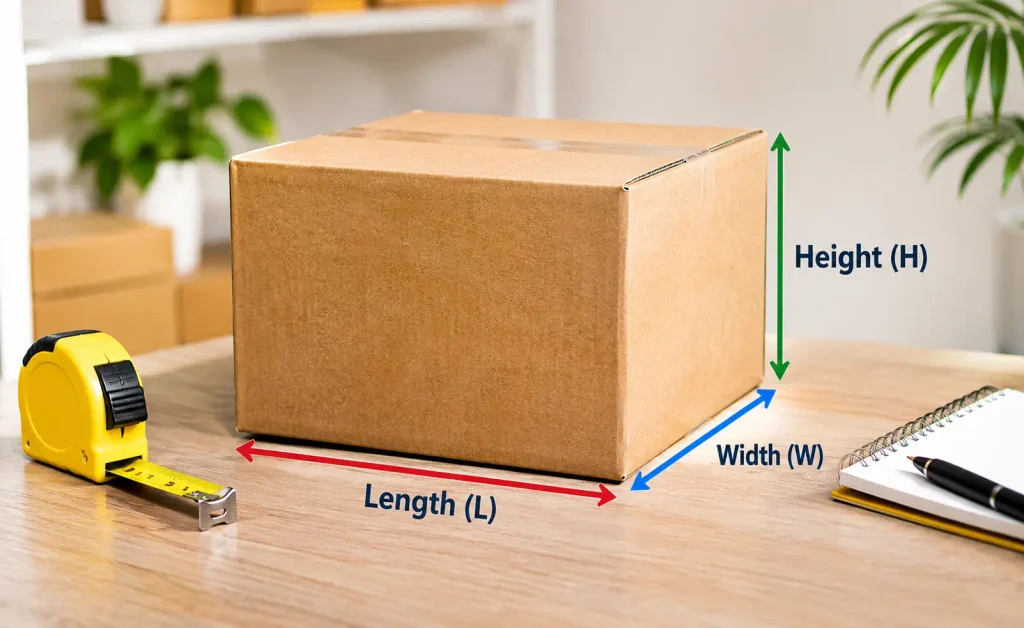
Length (L)
Usually the longer side of the box’s rectangular base.
Width (W)
The shorter side of the base, perpendicular to the length.
Height (H)
The distance from the bottom to the top in the box’s designated position.
For example, a box measuring 12 inches long, 8 inches wide, and 6 inches high is written as:
12 × 8 × 6 inches (L × W × H)
These three numbers describe the box’s dimensions. Multiplying them gives its rectangular volume, measured in cubic units.
What Is the Correct Order of Length, Width, and Height?
For most rectangular packaging applications, dimensions are written in this order:
Length × Width × Height (L × W × H)
For example, 16 × 12 × 8 inches means the box has a 16-inch length, 12-inch width, and 8-inch height.
The order matters because changing the labels can change the intended orientation of a box. A box described as 12 × 8 × 6 inches has the same calculated volume as 12 × 6 × 8 inches, but the two specifications describe different orientations.
Although L × W × H is common in packaging, some industries use width × depth × height or other formats. Always confirm the supplier’s measurement convention before ordering.
Length vs. Width vs. Height: Quick Comparison
| Dimension | What It Measures | Example |
|---|---|---|
| Length | Longer side of the rectangular base | 14 inches |
| Width | Other base side, perpendicular to length | 10 inches |
| Height | Bottom-to-top measurement | 8 inches |
A tall box can have a height greater than its length. Therefore, length does not always mean the longest dimension of the entire box.
How to Measure Length, Width, and Height of a Box
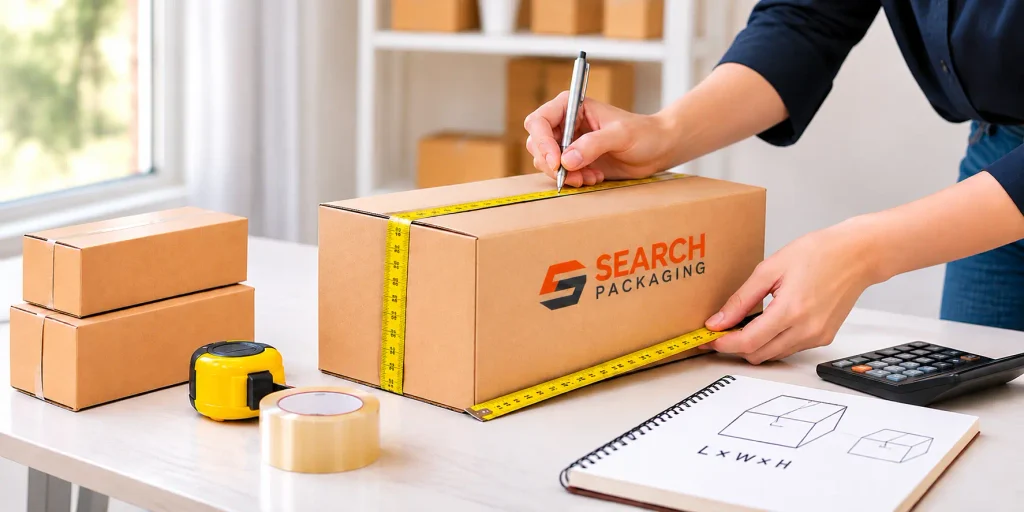
To measure a box correctly, use a ruler or measuring tape and place the assembled box on a flat surface.
Step 1: Prepare the Box
Assemble the box and close its flaps or lid. Make sure the sides are not bent or compressed. Decide whether you need internal or external dimensions.
Step 2: Measure the Length
Identify the longer side of the rectangular base. Measure straight from one end to the other.
For example: L = 15 inches
Step 3: Measure the Width
Measure the other side of the base, perpendicular to the length. Keep the measuring tape straight.
For example: W = 10 inches
Step 4: Measure the Height
Measure from the bottom to the top of the assembled box in its intended orientation.
For example: H = 7 inches
Step 5: Record and Verify
Write the measurements as:
15 × 10 × 7 inches (L × W × H)
Measure again to confirm accuracy. If the box has inserts, folded walls, or unusual closures, check the usable space before placing an order.
For custom packaging, clearly state whether the measurements are internal or external.
How to Write Box Dimensions Correctly
The clearest way to write box dimensions is to include the measurements, unit, and dimension order.
Example: 10 × 8 × 4 inches (L × W × H)
You can also write them separately:
- Length: 10 inches
- Width: 8 inches
- Height: 4 inches
Both formats are acceptable when the labels are clear.
Examples of LWH Measurements
| Box Type | Example Dimensions |
| Small retail box | 6 × 4 × 2 inches |
| Rectangular mailer | 12 × 9 × 3 inches |
| Shipping carton | 16 × 12 × 8 inches |
| Tall product box | 5 × 4 × 12 inches |
These are illustrative measurements, not universal standard sizes.
In the United States, packaging dimensions are commonly expressed in inches. If a supplier requires centimeters or millimeters, use the requested unit consistently.
What Is the Difference Between 2D and 3D Dimensions?
Two-dimensional measurements describe a flat geometric shape using length and width. Three-dimensional measurements describe an object using length, width, and height.
Two-Dimensional Measurements
A rectangle has length and width. Its area is calculated using:
Area = Length × Width
For a rectangle measuring 18 × 12 inches:
18 × 12 = 216 square inches
Three-Dimensional Measurements
A rectangular box has length, width, and height, allowing its volume to be calculated. Examples include shipping cartons, mailer boxes, gift boxes, and retail packaging.
A physical sheet of cardboard also has thickness, although its flat layout is often treated as a two-dimensional design.
How to Calculate the Volume of a Box
Box volume represents the three-dimensional space occupied by a rectangular box.
BOX VOLUME FORMULA
- No tags
Example of L × W × H Calculation
Suppose a box measures:
- Length: 16 inches
- Width: 12 inches
- Height: 8 inches
Multiply the measurements:
16 × 12 × 8 = 1,536 cubic inches
To convert cubic inches into cubic feet:
1,536 ÷ 1,728 = 0.889 cubic feet, approximately.
If you use outside measurements, the result is the external rectangular volume. Using internal measurements gives the approximate internal capacity before accounting for inserts, folds, or other obstructions.
Box Volume Calculator
📦 Box Volume Calculator
Calculate your box volume in seconds.
CALCULATED VOLUME
1,536 in³
0.889 cubic feet
Formula: Length × Width × Height
Internal vs. External Box Dimensions
Internal and external dimensions serve different purposes. Understanding the difference helps prevent packaging and shipping errors.
Internal Dimensions
Internal dimensions measure the usable space inside a box. They are important for checking product fit and planning protective inserts.
For example, a box with internal dimensions of 10 × 8 × 4 inches provides that nominal rectangular interior space, subject to any folds or other obstructions.
External Dimensions
External dimensions measure the complete outside size of the assembled box, including its material thickness. These measurements are important for shipping calculations, warehouse storage, and shelf-space planning.
| Purpose | Recommended Measurement |
| Checking product fit | Internal dimensions |
| Designing inserts | Internal dimensions and usable clearances |
| Calculating shipping dimensional weight | External dimensions |
| Planning storage | External dimensions |
| Ordering custom boxes | Confirm supplier requirements |
The difference between internal and external dimensions depends on material thickness, construction, and box style. Do not assume a fixed difference for every box.
Product Dimensions vs. Box Dimensions
Product dimensions describe the item being packaged, while box dimensions describe the packaging itself.
For example, if a product measures 8 × 6 × 3 inches, a box with exactly the same internal dimensions may be too tight once cushioning or wrapping is added.
To select an appropriate box:
- Measure the product in its intended packing position.
- Include accessories, inserts, and protective materials.
- Determine the necessary clearance.
- Check the box’s usable internal dimensions.
- Test a physical sample when the fit is critical.
There is no single clearance allowance suitable for every product. Fragility, shape, and protective material determine how much additional space is necessary.
Why Accurate Box Dimensions Matter
Accurate box measurements affect product protection, shipping costs, storage efficiency, and packaging design.
Product Protection
An undersized box may compress the product or prevent proper closure. An oversized box may allow movement during shipping unless suitable cushioning is used.
Shipping Costs
Shipping carriers may use dimensional weight to calculate charges for packages that occupy considerable space relative to their actual weight. Choosing a properly sized box can help reduce unnecessary shipping volume.
Storage and Stacking
External dimensions help businesses plan warehouse shelves, pallet layouts, and available storage space.
Packaging Design and Printing
Box dimensions affect panel sizes, dielines, artwork placement, folds, and closure mechanisms. Incorrect measurements can create problems during production.
Accurate sizing also helps control packaging material consumption. For related budgeting considerations, see how box size and material affect custom packaging costs.
How Box Dimensions Affect Dimensional Weight
Dimensional weight, also called DIM weight, is a shipping calculation based on a package’s external dimensions.
The general formula is:
Dimensional Weight = (Length × Width × Height) ÷ DIM Divisor
The divisor varies according to the carrier, service, and shipping agreement.
Dimensional Weight Example
Suppose a box measures 16 × 12 × 8 inches.
Its volume is:
16 × 12 × 8 = 1,536 cubic inches
Using a divisor of 139 for illustration:
1,536 ÷ 139 = 11.05 pounds, approximately.
If the applicable carrier rounds the result up to the next whole pound, the dimensional weight becomes 12 pounds.
If the actual package weighs 5 pounds and the carrier bills using the greater of actual and dimensional weight, the dimensional weight determines the billable weight. This is an illustrative calculation, not a guaranteed shipping charge. Always verify the carrier’s current divisor, rounding rules, and applicable service conditions. For official information, review UPS dimensional weight guidance.
Dimensional Weight Calculator
Dimensional Weight Calculator
Calculate the dimensional and billable weight of your shipping box.
Example divisors: 139 for in³/lb or 5000 for cm³/kg. These are examples, not universal carrier rules. Enter the divisor required by your shipping service. If you change units, check the divisor.
Calculation Results
*Estimated before carrier-specific rounding and other shipping rules.
[HTML section recommended: Calculator with length, width, height, actual weight, and an editable DIM divisor.]
Does Box Style Change How You Measure It?
The basic L × W × H method works for many rectangular packaging styles, but the exact measurement points may vary.
Shipping Boxes
Measure the assembled carton with its flaps closed. Use internal measurements for product fit and external measurements for shipping.
Mailer Boxes
Mailer boxes often contain folded walls, locking tabs, and lids that reduce usable space. Measure the assembled box rather than only its flat dieline.
Folding Cartons
Measure the finished carton in its erected shape. Confirm the panel orientation and closure design before approving printing artwork.
Rigid Boxes
Rigid boxes may have separate bases and lids with different dimensions. Check both components where necessary. For any custom structure, a dieline or physical sample can help verify the final measurements.
Best Tools for Measuring Box Dimensions
You do not need specialized equipment for ordinary rectangular boxes. The following tools cover most measurement tasks.
| Tool | Best Use |
|---|---|
| Ruler | Small cartons |
| Measuring tape | Medium and large boxes |
| Yardstick | Long straight edges |
| Digital caliper | Small measurements and material thickness |
| Notebook or spreadsheet | Recording measurements |
Keep the measuring tool straight, align its zero point correctly, and use consistent units.
Common Mistakes When Measuring Box Dimensions
Avoid these common mistakes before ordering or shipping boxes:
- Confusing length and width: Confirm the base orientation and label each measurement.
- Mixing internal and external dimensions: Use the correct measurement for the intended purpose.
- Forgetting cushioning: Measure the complete packed arrangement, not just the bare product.
- Mixing inches and centimeters: Record all measurements in a consistent unit.
- Measuring a flat box: Assemble the box before measuring its finished dimensions.
- Ignoring folds and closures: Check any features that reduce usable space.
- Rounding too early: Record accurate values and apply rounding only when required.
These checks help reduce errors in box specifications and packaging orders.
Box Measurement Checklist Before Ordering
Before submitting dimensions to a supplier, confirm:
- Product dimensions are measured correctly.
- Length, width, and height are labeled.
- All measurements use consistent units.
- Internal and external dimensions are identified.
- Cushioning and inserts are included in the fit check.
- Box style and closures are confirmed.
- Shipping calculations follow the carrier’s rules.
- A physical sample has been tested when necessary.
Conclusion
Understanding length, width, and height dimensions is essential for selecting the right packaging. For most rectangular boxes, the common format is L × W × H, with length and width describing the base and height describing the third dimension.
Accurate measurements help ensure product fit, support shipping calculations, and improve packaging efficiency. Always distinguish internal from external dimensions, account for protective materials, and confirm specifications with your packaging supplier.
For more guidance on packaging materials, box styles, and practical packaging decisions, explore Search Packaging.
Frequently Asked Questions
1. What is L × W × H?
L × W × H means Length × Width × Height. It is a common format for describing the three dimensions of a rectangular box.
2. What comes first in box dimensions?
Length usually comes first, followed by width and height. However, always confirm the measurement order required by your supplier.
3. Is length always the longest measurement?
No. Length usually refers to the longer side of a rectangular base. A tall box may have a height greater than its length.
4. How do you measure a box correctly?
Place the assembled box on a flat surface. Measure its length, width, and height in the intended orientation, then record the values using consistent units.
5. Should box dimensions be measured inside or outside?
Use internal dimensions to check product fit and external dimensions for shipping and storage calculations.
6. How do you calculate box volume?
Multiply length by width by height. A box measuring 10 × 8 × 5 inches has a volume of 400 cubic inches.
7. What is the difference between height and depth?
Height usually describes the vertical dimension, while depth often describes the front-to-back measurement. Terminology varies by product and packaging style.
8. Why are accurate box dimensions important for shipping?
Accurate external dimensions help determine package size and dimensional weight, which can affect shipping charges.
Packaging Expert & Industry Writer