
Turn over any package that lands on your doorstep and you will spot a few small printed icons near the edge. A glass with a crack. An umbrella. Two arrows pointing up. These packaging symbols look tiny, but they do a big job. They tell warehouse staff and delivery drivers how to move the box, they warn people about hazards, and they help recycling centers sort material the right way.
If you sell products in the USA, knowing what these symbols mean saves you money. The right icons cut damage claims, keep you on the right side of federal and state rules, and make your brand look careful and professional. Understanding these details can also help businesses make informed decisions about custom packaging costs. This guide walks through every major group of symbols, explains which ones are legally required, and covers a brand new California rule that is changing how recycling symbols can be used.
Want the right symbols built into your design from day one? Understanding packaging symbols is an important step in creating safer, more sustainable packaging. Explore Search Packaging for more insights into packaging materials, labeling, design, and industry standards to make informed decisions for your products.
Quick Answer: What Do Packaging Symbols Mean?
Packaging symbols are small pictures printed on boxes, labels, and wrappers. Each one has a single job:
- Handling symbols show how to carry, stack, and store the box.
- Hazard symbols warn about dangerous contents.
- Food, cosmetic, and medical symbols share safety, shelf life, and ingredient details.
- Recycling symbols explain what the material is and how to dispose of it.
- Compliance marks prove the product or box meets a rule or standard.
Some of these come from official standards. Others come from certification groups or simple industry habits. Knowing which is which matters, especially when comparing packaging options and learning about packaging companies in the USA. We’ll break down the different types of symbols and explain what they mean below.
Where Packaging Symbols Come From
Most shipping and handling icons follow ISO 780, a standard from the International Organization for Standardization (ISO) that sets the look of handling and storage marks. In the USA, ASTM D5445 covers pictorial markings for handling goods and matches the ISO designs closely. Hazard marks on dangerous goods are set by the Department of Transportation (DOT). Food labels fall under the Food and Drug Administration (FDA), organic claims under the USDA, and environmental claims under the Federal Trade Commission (FTC) and a growing list of state laws.
That mix explains why some symbols are the same worldwide while others only count in one country or one industry.
Also read: How Much Does A Pack Of Cigarettes Cost In The USA?
Handling and Protection Symbols
These icons protect the product while it is stored, loaded, and shipped. They are also called transit packaging symbols or package handling symbols.
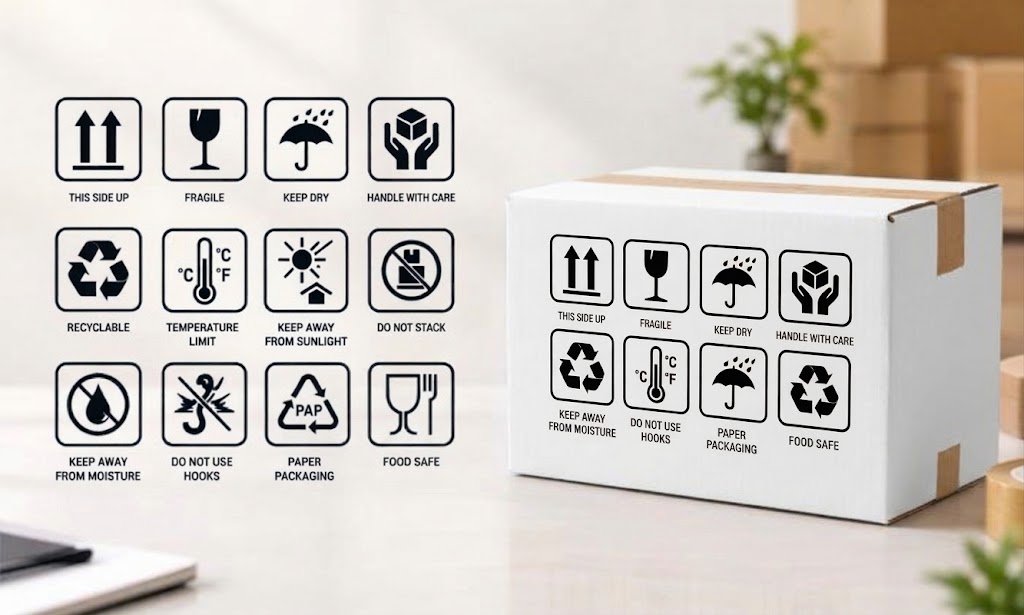
Fragile. A broken glass tells handlers the contents can crack or shatter. You will see it on glassware, ceramics, electronics, and delicate retail items packed in rigid boxes.
This Way Up. Two arrows pointing upward mean the box must stay upright the entire trip. Use it for liquids, machinery, and anything that can leak or tip.
Keep Dry. An umbrella with raindrops warns that water or humidity can ruin the contents. It is common on paper goods, electronics, and dry food.
Handle With Care. Two hands holding a box ask for slow, gentle movement. It is broader than Fragile, so it suits items that will not break but can still be dented or scratched.
Do Not Stack. A box with a cross over the one on top means nothing heavy should sit on this carton. Gift boxes and decorative packaging often carry it.
Maximum Stack Height. A pile of boxes with a number shows how many identical cartons can safely go on top.
Center of Gravity. A mark that shows where the weight sits. It helps handlers balance long or lopsided boxes.
Do Not Use Hooks. A hook with a cross over it warns that cargo hooks will tear the carton.
Do Not Cut With Knife. A crossed-out blade protects the product inside, which matters for pillows, mattresses, and printed goods that a box cutter could slice.
Two Person Lift. Two figures carrying a box flag a package that is too heavy or awkward for one person.
Storage and Temperature Symbols
These marks describe the conditions the product needs while it waits in a warehouse or on a truck.
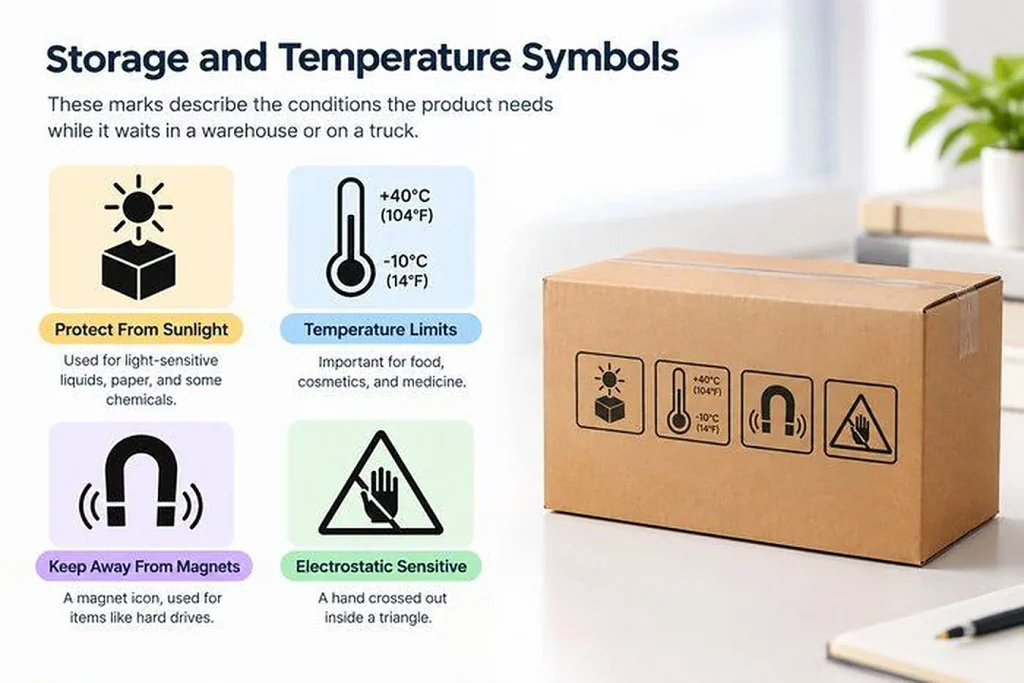
- Protect From Sunlight: a sun above a box. Used for light-sensitive liquids, paper, and some chemicals.
- Temperature Limits: a thermometer with upper and lower numbers. Important for food, cosmetics, and medicine.
- Keep Away From Magnets: a magnet icon, used for items like hard drives.
- Electrostatic Sensitive: a hand crossed out inside a triangle. It marks electronics that static can damage.
A quick reminder: a symbol asks people to behave a certain way. It does not protect the product on its own. A fragile mark helps, but good inner packaging is still what keeps glass from breaking.
Hazard and Warning Symbols
Handling icons protect the product. Hazard marks protect the people who touch it. For dangerous goods shipped in the USA, the DOT requires diamond-shaped labels that show the hazard class.
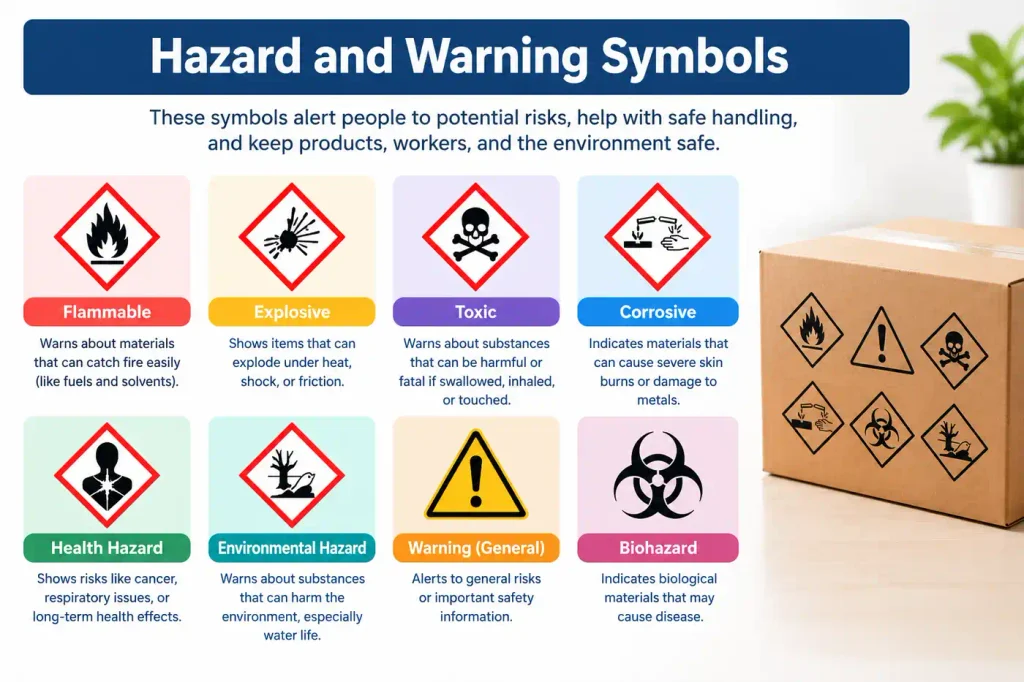
- Flammable: a flame. Contents can catch fire, so keep them away from heat and sparks.
- Corrosive: liquid dripping on a hand and a surface. The contents can burn skin or eat through materials.
- Biohazard: a three-part trefoil used for biological material that could cause disease, mostly in medical and lab shipping.
- Radioactive: a trefoil with three blades for radioactive material.
- Lithium Battery Mark: a rectangle with a battery icon and a red hatched border. It is now one of the most common regulated marks in ecommerce because phones, laptops, and power banks all use these batteries.
- General Caution: an exclamation point in a triangle, usually paired with a short written warning.
- California Prop 65 Warning: a yellow triangle with an exclamation point. It is required on products sold in California that contain certain listed chemicals.
Food Packaging Symbols
Food packaging symbols tell shoppers what is safe, what suits their diet, and how to store the product. Food labeling rules come from the FDA.
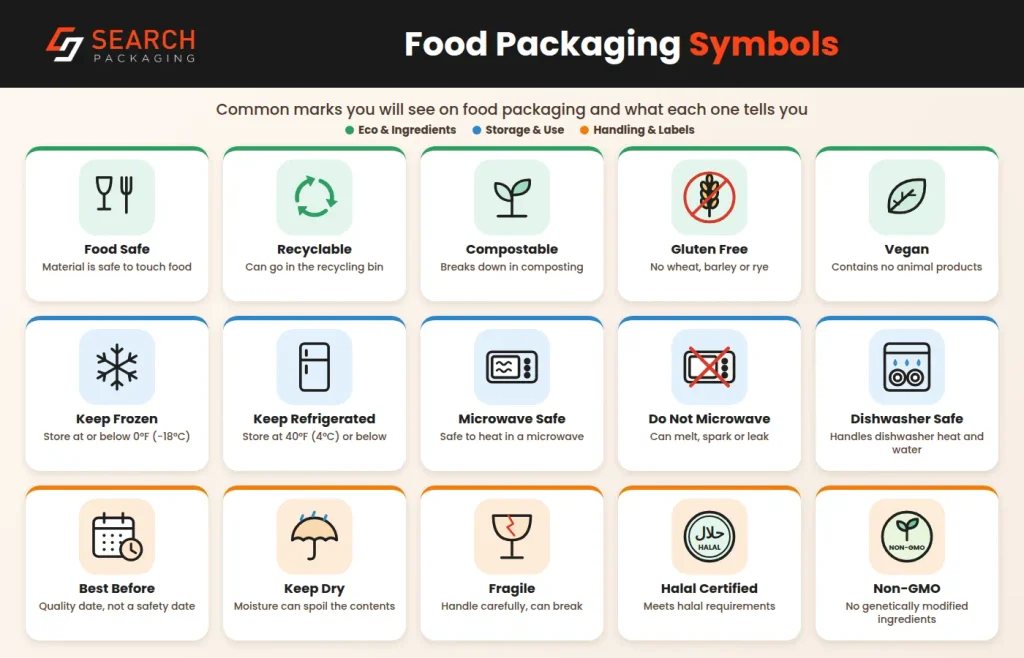
- Food Safe: a glass and fork. The material is approved for direct food contact.
- Microwave Safe: a dish with wavy heat lines.
- Freezer Safe: a snowflake.
- Gluten Free: a crossed-out ear of wheat. Many brands also use certification logos, so check that the logo is real before copying it.
- Vegetarian and Vegan: leaf or “V” marks. Several are owned by certification groups, so use only the ones you are licensed for.
- Allergen Warning: the FDA requires clear labeling of the nine major allergens, including milk, eggs, peanuts, tree nuts, soy, wheat, fish, shellfish, and sesame.
- USDA Organic: the round green seal. A product can carry it when at least 95 percent of its ingredients are certified organic.
Also read: Cereal box dimensions
Cosmetic Packaging Symbols
Beauty and skincare shoppers care about shelf life and sourcing, so cosmetic packaging uses its own icons.
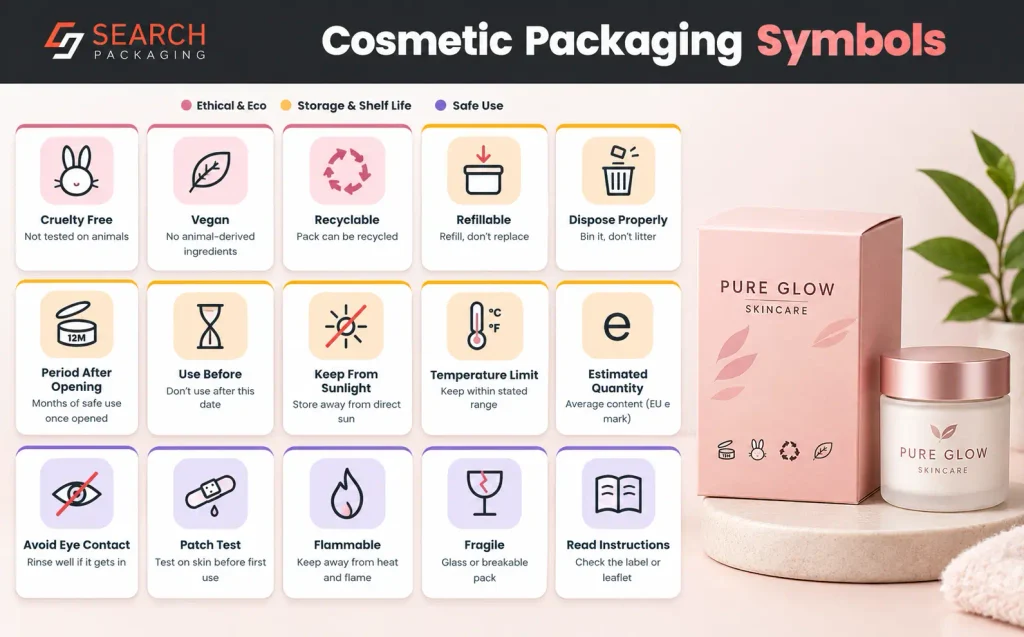
- Period After Opening (PAO): an open jar with a number such as 12M. It tells you how many months the product stays good once opened. It is an industry habit in the USA rather than a federal rule.
- Leaping Bunny: a running rabbit from a certification program for products that are not tested on animals. You need approval to print it.
- Expiry or Best Before Date: usually shown as text or a date format, so customers know when quality drops.
Medical and Pharmaceutical Symbols
Medical packaging has the strictest symbol rules because a missed icon can put a patient at risk. Many device symbols come from the ISO 15223-1 standard.
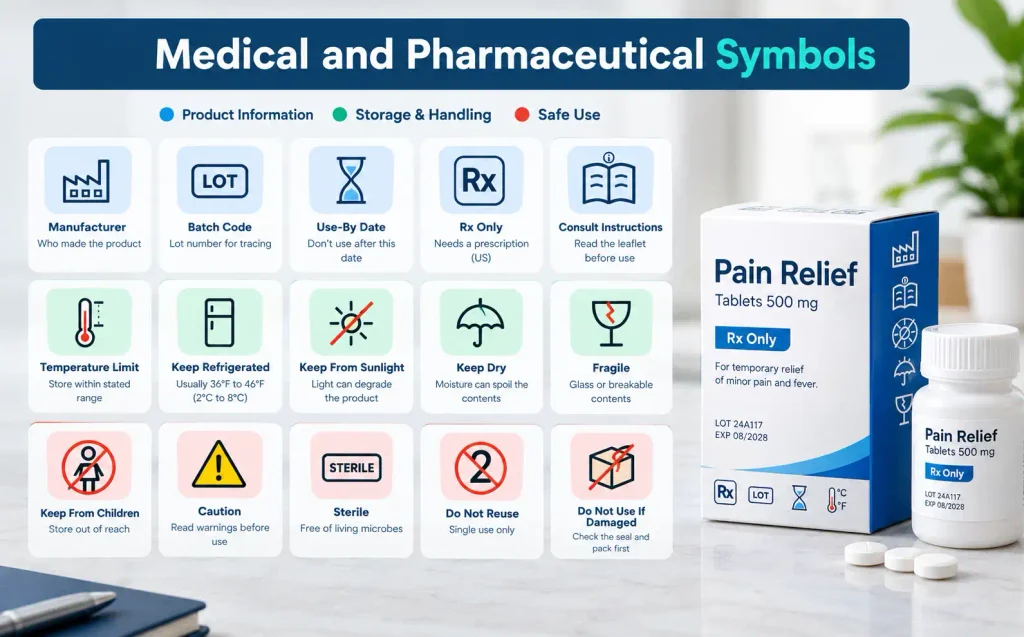
- Single Use: a crossed-out number 2. Never reuse or re-sterilize.
- Sterile: a package with sterilization wording or lines.
- Non Sterile: the word sterile with a cross through it.
- Manufacture Date: a small factory icon next to a date.
- Tamper Evident: a seal or band that clearly shows if someone opened the pack. The FDA requires tamper-evident packaging on many over-the-counter products.
Environmental and Recycling Symbols
Shoppers in the USA pay attention to sustainability, so recycling icons carry real weight on a box, whether it is printed cardboard or natural kraft packaging. They are also the area where mistakes cost the most.
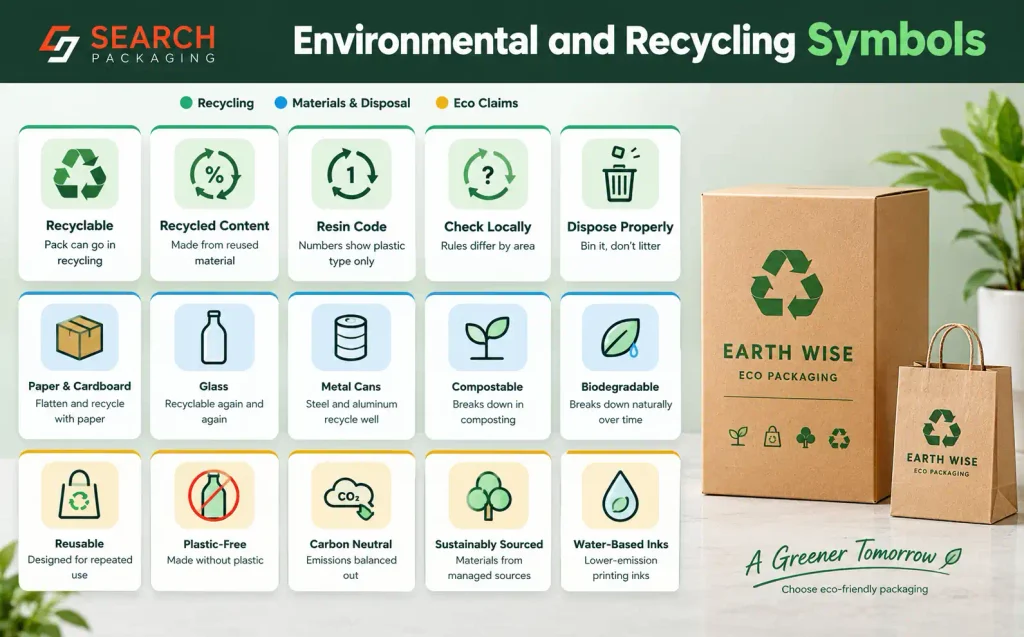
Mobius Loop (chasing arrows). Three arrows chasing each other in a triangle. It suggests the material can be recycled, but your local program decides what it actually accepts.
Recycled Content Loop. The same loop with a percentage inside. It says how much of the material is already recycled. That is a different claim from “recyclable.”
Resin Identification Code. A number from 1 to 7 inside a triangle. It names the type of plastic so sorting plants can handle it.
FSC Certification. A tree with a check mark. It shows that paper or board comes from forests managed to Forest Stewardship Council standards. You need a license to print it.
How2Recycle Label. A common label on US packaging that tells customers, part by part, whether to recycle, drop off, or throw away each piece.
Compostable Marks. A sprouting plant or a certification logo for packaging that breaks down in composting conditions. Many of these only work in commercial composting, not in a backyard bin.
Green Dot and Tidy Man. You will see these on imported goods. Green Dot shows payment into a European recovery scheme, and the Tidy Man simply asks people not to litter. Neither is a US recycling instruction.
Myth check: a resin number does not mean a plastic is recyclable where you live. It only names the plastic. In most US communities, plastics 1 (PET) and 2 (HDPE) are accepted widely, while 3 through 7 often are not. The number and the loop answer two different questions.
California’s Truth in Recycling Law (SB 343)
This is the biggest recent change for anyone printing recycling symbols in the USA, and many guides still skip it.
California’s SB 343 took effect on October 4, 2026. Under this law, using the chasing arrows symbol, a resin code inside the arrows, or any wording that says an item is recyclable counts as misleading unless the product meets the state’s recyclability criteria. The rules apply based on the date the product was made, not the date it was sold. Brands must also keep documents that prove their claim, and consumers can ask for them.
A federal court has paused enforcement of parts of the law, so the legal picture may keep shifting. Even so, the safest move is to check every recycling claim on your packaging, keep proof, and talk to a legal adviser if you sell into California. Boxes made of plain corrugated board are often easier to support than mixed-material packaging, which is one reason many brands are rethinking their materials. For more on this direction, read our guide on sustainable packaging trends.
International Compliance and Shipping Symbols
- CE Marking: the letters CE. This is a legal declaration that a product meets European Union rules. It is not a quality badge and is not needed for domestic US shipping.
- UN Packaging Mark: a code showing the box passed United Nations testing for dangerous goods such as chemicals, batteries, and aerosols.
- ISPM 15 Stamp: a stamp on wooden pallets and crates showing the wood was heat treated to stop pests. It is required for wooden packaging leaving the USA.
- Fragile Air Cargo: a plane next to a glass, used to ask for extra care in air freight.
Packaging Symbols Chart at a Glance
| Symbol | What It Looks Like | Where It Is Used |
| Fragile | Broken glass | Glassware, electronics, ecommerce parcels |
| Keep Dry | Umbrella with rain | Paper goods, electronics, dry food |
| This Way Up | Two arrows above a line | Liquids, machinery, upright-only items |
| Handle With Care | Hands holding a box | Phones, laptops, delicate retail goods |
| Do Not Stack | Crossed-out top box | Gift boxes, retail packaging |
| Max Stack Height | Stacked boxes with a number | Bulk cartons, beverage and produce boxes |
| Mobius Loop | Three chasing arrows | Cardboard, paper, plastic |
| Resin Code | Number 1 to 7 in a triangle | Bottles, trays, clamshells |
| Lithium Battery Mark | Battery icon with red border | Electronics shipments |
| CE Marking | The letters CE | Products sold in the EU |
| ISPM 15 | Heat treatment stamp | Wooden pallets and crates for export |
| Biohazard | Orange trefoil | Medical and lab shipments |
Want a printable version for your warehouse team? Ask us for a symbol sheet when you request a quote.
Which Packaging Symbols Are Legally Required in the USA?
This question confuses a lot of packaging buyers. Here is a clear split.
Required in specific situations
- Hazard marks and labels for flammable, corrosive, biohazard, and radioactive goods, when the shipment counts as dangerous goods under DOT rules.
- The lithium battery mark on qualifying battery shipments.
- UN packaging marks on containers that carry regulated dangerous goods.
- Nutrition and allergen information on food packaging, under FDA rules.
- Prop 65 warnings on products sold in California that contain listed chemicals.
- ISPM 15 stamps on wooden packaging sent abroad.
- CE marking, only for products entering the European Union.
- Special labeling for regulated products. CBD packaging, for example, has state and federal rules on top of the usual marks.
Optional but smart
- Handling symbols such as Fragile, Keep Dry, This Way Up, and Handle With Care. No law forces you to print them, but they help reduce damage and returns.
- Recycling symbols. These are voluntary in most states, but when you do use them, your claim has to be true. California now enforces this strictly, and the FTC has long warned against misleading environmental claims.
- Cosmetic icons like PAO and Leaping Bunny.
Simple rule: if a symbol is about safety, transport, or a regulated product, treat it as a must. If it is about careful handling or green messaging, treat it as a smart extra, and make sure it is accurate.
How to Choose the Right Symbols for Your Box
- Start with your product’s risk. Breakable items need Fragile and This Way Up. Moisture-sensitive items need Keep Dry. Electronics may need the electrostatic mark, and the lithium mark if batteries are inside.
- Check your regulated category. Food, cosmetics, medical devices, and dangerous goods each have required marks that come before any optional ones.
- Only print claims you can prove. Use the recycling loop, a resin code, or the FSC logo only when it truly applies and you have the paperwork.
- Place symbols where people look. The usual spot is the upper corner of two side panels. Print in black and make them large enough to read from an arm’s length away. Good placement starts with correct panel sizing, which we cover in our box dimensions guide.
- Keep the set small. Three to five clear icons get noticed. A crowd of twelve gets ignored.
How to Identify an Unknown Packaging Symbol
- Look at the shape. Is it a picture of a person, a product, a flame, or an arrow?
- Decide which group it belongs to: handling, hazard, recycling, food, or certification.
- Read any nearby numbers, letters, or words.
- Match it to the standard or certification body that owns it.
- Do not assume a recycling or certification claim from the image alone. Check the source.
Common Symbol Mistakes to Avoid
- Printing the recycling loop on a package that your local program does not accept.
- Using a certification logo, such as FSC or Leaping Bunny, without a license.
- Adding CE marking to products that never leave the USA.
- Printing too many icons so none of them stand out.
- Making icons too small or placing them where a label or tape will cover them.
- Copying a symbol from the internet in a low-quality file, which blurs when printed.
How the Right Symbols Help Your Business Ship Safely
For a growing ecommerce brand, good symbols do three things. They cut damage claims by telling every handler how to treat the box, whether it travels in plain shipping boxes or branded custom mailer boxes. They build trust, because customers see clear, careful information the moment the parcel arrives. And they help you stay in line with transport, food, and labeling rules without checking every single carton by hand.
Brands that consider packaging symbols during the design stage can improve handling, product protection, and recycling clarity. Understanding where and how to use these icons helps businesses make informed packaging decisions. Explore Search Packaging for more insights into packaging design, labeling standards, and industry best practices.
Frequently Asked Questions
What are packaging symbols?
Packaging symbols are small pictures printed on boxes and labels that share handling steps, safety warnings, recycling details, and compliance information without using words.
What are the most common packaging symbols?
The five most recognized are Fragile, Keep Dry, This Way Up, Do Not Stack, and the Mobius recycling loop.
What is the difference between the Fragile and Handle With Care symbols?
Fragile warns that the contents can break or shatter, like glass or ceramics. Handle With Care is wider. It covers items that will not break easily but can still be damaged by rough handling, such as electronics.
Does the recycling number mean a package is recyclable?
No. The resin number only tells you the type of plastic. Whether it is recycled depends on your local program. In most of the USA, plastics 1 and 2 are accepted most widely.
Can I print the recycling symbol on my packaging in California?
Only if your packaging meets the state’s recyclability rules under SB 343, and you can back up the claim with documents. Check the latest legal status and speak with a legal adviser if you sell to California customers.
Do I need a license to use a packaging symbol?
Most handling icons are free to use. Certification marks such as FSC, USDA Organic, and Leaping Bunny need approval or a license before you print them.
Which packaging symbols are required by law in the USA?
Hazard marks, the lithium battery mark, UN packaging marks, FDA food and allergen labels, Prop 65 warnings where they apply, and ISPM 15 stamps on export wood. Handling icons are voluntary.
Are packaging symbols the same in every country?
Core handling symbols like Fragile and This Way Up are understood almost everywhere. Marks such as CE, Green Dot, and country recycling codes only apply in certain regions, so check the rules of your destination market.