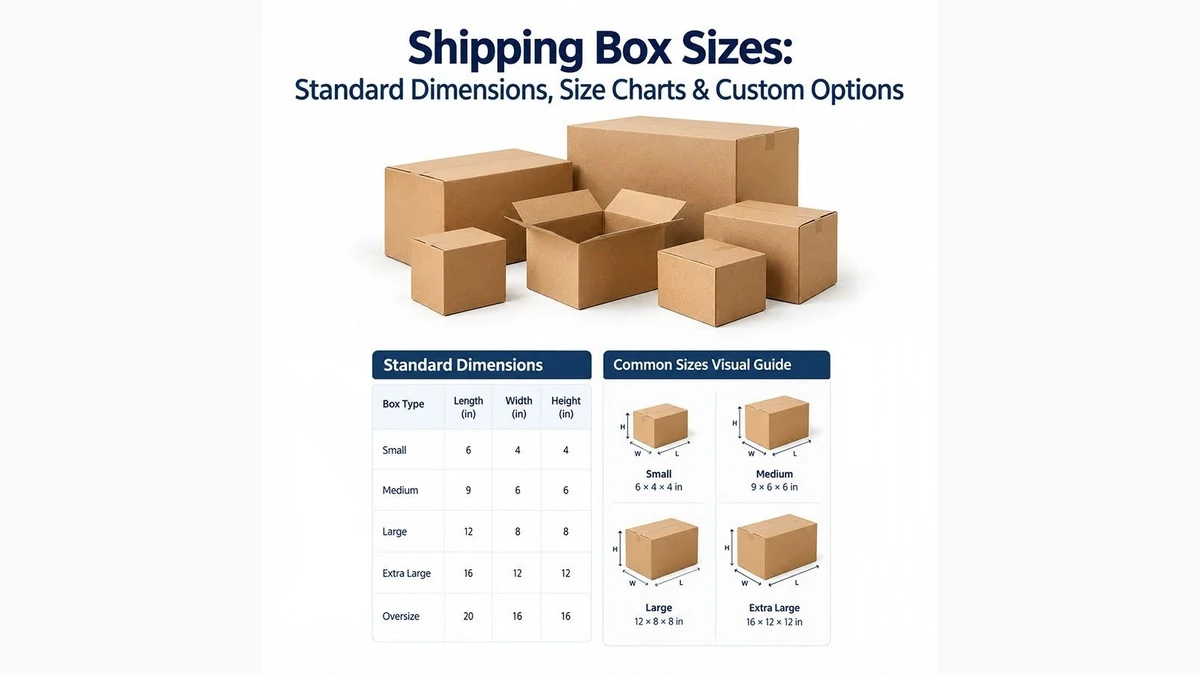
Standard shipping box sizes range from compact 4 x 4 x 4 inch cubes for small electronics to 30 x 30 x 30 inch cartons for bulk and oversized goods.
The sizes most used in e-commerce are (in inches):
- 8 x 6 x 4
- 8 x 8 x 8
- 10 x 10 x 10
- 12 x 12 x 12
- 16 x 12 x 12
- 16 x 16 x 16
- 24 x 12 x 12
Box dimensions are listed as Length x Width x Height.
Box size affects three things:
- Shipping cost
- Product protection
- Packing efficiency
FedEx and UPS price packages by dimensional (DIM) weight using a divisor of 139.
USPS applies dimensional weight pricing to eligible domestic packages larger than one cubic foot. The divisor is generally 139, although specific Priority Mail pricing conditions may use 166. Always check the applicable service and destination zone.
As a result, an oversized box can cost more to ship than the product’s actual weight would suggest.
The general sizing rule: choose the smallest box that leaves about 2 inches of cushioning on every side of the item.
Standard Shipping Box Sizes Quick Reference
Box Size (inches): Typical Uses
- 4 x 4 x 4: Small electronics, jewelry, craft supplies
- 8 x 6 x 4: Apparel, accessories, small gifts
- 8 x 8 x 8: Candles, books, small electronics
- 10 x 10 x 10: Collectibles, cosmetics sets, small home goods
- 12 x 12 x 12: Home goods, toys, multi-item orders
- 16 x 12 x 12: Kitchen gadgets, medium appliances, decorative home goods
- 16 x 16 x 16: Ceramics, glassware, picture frames, delicate electronics
- 24 x 12 x 12: Automotive parts, heavy items, combined shipments
- 18 x 18 x 28: Bulky items, small furniture, lamps
- 30 x 30 x 30: Bulk orders, oversized goods, moving
How to Choose the Correct Shipping Box Size
The correct shipping box size depends on four factors:
- The product’s dimensions
- Its fragility
- Its weight
- The distance it will travel
The box’s interior should be 2 to 3 inches larger than the product on each side.
That leaves room for bubble wrap, foam inserts, air pillows, or packing paper.
Fragile items such as ceramics, glassware, and picture frames require a larger box with room for protective padding. A 16 x 16 x 16 box is a common choice for these products.
Heavy items such as automotive parts require a sturdy, higher-strength box, such as a double-wall 24 x 12 x 12 box.
Bulky items such as small furniture require large cartons, such as an 18 x 18 x 28 box, that fit the item with room for padding.
Lightweight soft goods such as clothing and accessories fit an 8 x 6 x 4 box, whose snug fit keeps contents stable during transit.
Custom box sizes are the recommended option for unique products.
A custom box provides an exact fit, which:
- Reduces void fill
- Improves protection
- Lowers DIM weight
- Creates a stronger unboxing experience for customers
Why Shipping Box Size Matters
Shipping box size directly affects:
- Cost
- Product safety
- Brand reputation
An oversized box, such as a 30 x 30 x 30 box used for a small product, raises shipping fees through DIM weight pricing and wastes packing material.
An undersized box, such as an 8 x 8 x 8 box used for an item that needs padding, leaves the product exposed to impact and crushing.
The most common problems caused by incorrect shipping box sizes are:
- Higher shipping fees due to oversized boxes and DIM weight charges.
- Product damage due to insufficient cushioning.
- Wasted space in trucks and shipping containers, which lowers efficiency.
- Increased returns, replacement costs, and negative customer reviews.
Correct box sizing reduces damage rates, lowers per-package shipping costs, and protects brand reputation.
Box Volume and DIM Weight Explained
Box volume is the amount of space a box occupies, calculated by multiplying length, width, and height.
Dimensional weight (DIM weight) is a pricing method carriers use to charge for that space.
- FedEx and UPS calculate DIM weight by dividing cubic inches by 139.
- USPS divides by 166 and applies DIM pricing to packages larger than one cubic foot (1,728 cubic inches).
Carriers round dimensions and weight up to the next whole number.
The billable weight is the greater of the actual weight and the DIM weight.
| Box Size (inches) | Volume (cubic inches) | DIM Weight, FedEx and UPS (lbs, rounded up) |
| 12 x 12 x 12 | 1,728 | 13 |
| 16 x 12 x 8 | 1,536 | 12 |
| 24 x 18 x 12 | 5,184 | 38 |
| 30 x 20 x 15 | 9,000 | 65 |
For example, a 3 lb product shipped in a 24 x 18 x 12 box is billed at about 38 lbs with FedEx or UPS.
Moving the same product into a 12 x 12 x 12 box lowers the billable weight to 13 lbs.
Online shipping cost calculators from FedEx, UPS, and USPS estimate rates from box dimensions and weight, which helps businesses compare box options before shipping.
Shipping Box Sizes by Carrier: FedEx, UPS, and USPS
FedEx, UPS, and USPS each provide branded packaging designed for specific services. These tuck top mailer boxes are free to use but are restricted to the services they are made for.
FedEx Box Sizes
FedEx branded boxes are available for FedEx Express shipments.
- FedEx Small Box (approx. 12.375 x 10.875 x 1.5 in): Documents and small electronics.
- FedEx Medium Box (approx. 13.25 x 11.5 x 2.375 in): Books and multiple small items.
- FedEx Large Box (approx. 17.5 x 12.375 x 3 in): Larger flat items and bulk documents.
UPS Box Sizes
UPS Express packaging is available for UPS air services.
- UPS Express Pak (approx. 16 x 12.75 in): Documents and lightweight soft goods.
- UPS Express Box Small (approx. 13 x 11 x 2 in): Personal items and small packages.
- UPS Express Box Medium (approx. 16 x 11 x 3 in): Office supplies and medium items.
- UPS Express Box Large (approx. 18 x 13 x 3 in): Larger flat items.
USPS Box Sizes
USPS Priority Mail Flat Rate boxes ship at one price regardless of weight, up to 70 lbs, to any domestic address.
- Small Flat Rate Box (interior approx. 8.625 x 5.375 x 1.625 in): Jewelry, small accessories.
- Medium Flat Rate Box, top-loading (interior approx. 11 x 8.5 x 5.5 in): Small to medium items, heavy compact goods.
- Large Flat Rate Box (interior approx. 12 x 12 x 5.5 in): Larger or heavier items.
USPS also offers free Priority Mail boxes in additional sizes, priced by weight and zone and including tracking.
Carrier box programs suit small, dense shipments. For larger, irregular, or high-volume shipments, standard corrugated boxes provide more size options and often lower total costs.
Summary
Standard shipping box sizes range from 4 x 4 x 4 inches to 30 x 30 x 30 inches.
The feasible box size depends on product dimensions, fragility, and weight. It also reduces shipping costs, prevents damage, and improves customer satisfaction.
The best box is the smallest one that allows about 2 inches of cushioning on all sides.
- FedEx and UPS bill by DIM weight using a 139 divisor.
- USPS uses 166 for packages over one cubic foot.
So oversized boxes increase costs.
- Single-wall 32 ECT boxes typically handle up to 65 lbs.
- Double-wall boxes suit heavier goods.
FedEx, UPS, and USPS branded boxes work for small express and flat rate shipments. Standard or custom corrugated boxes cover everything else. Search Packaging shares helpful insights and guides to help businesses explore different packaging options.