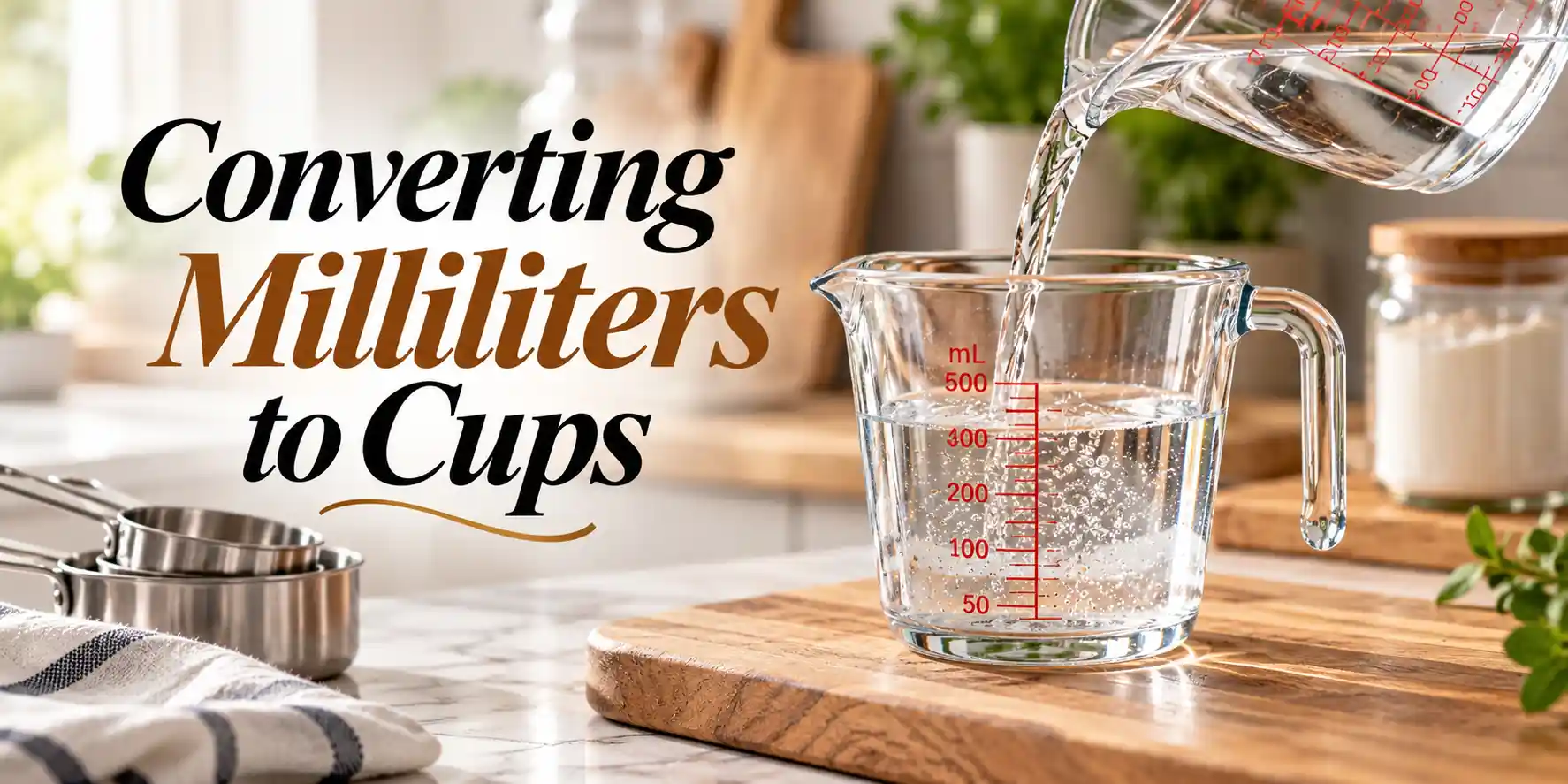
Following a recipe becomes confusing when the ingredients are measured in milliliters, but your measuring cups show cups instead. You might need 250 mL of milk, 500 mL of water, or 100 mL of cooking oil and wonder how much to pour.
Converting milliliters to cups is simple once you know the correct cup size. The important thing to remember is that one cup does not hold the same amount in every country. A standard US customary cup holds about 237 mL, while a metric cup holds 250 mL.
This guide explains how to convert mL to cups, use the correct formula, understand regional cup measurements, and measure liquids accurately. It also includes a conversion chart to help you find common measurements without doing the math each time.
Quick Answer: How Many Milliliters Are in a Cup?
One US customary cup contains approximately 236.59 milliliters (mL), while one metric cup contains exactly 250 mL.
- 1 US cup = 236.59 mL
- 1 metric cup = 250 mL
- 250 mL = 1.06 US cups
- 500 mL = 2.11 US cups
- 1,000 mL = 4.23 US cups
Conversion Formula: US Cups = Milliliters ÷ 236.588
For metric cups, divide milliliters by 250. Always check which cup standard your recipe uses for accurate results.
How Many Milliliters Are in One Cup?
One US customary cup equals approximately 236.59 milliliters (mL), while one metric cup equals exactly 250 mL.
The amount depends on which measuring system you use. American recipes generally follow US customary measurements, while Australian and New Zealand recipes commonly use metric cups.
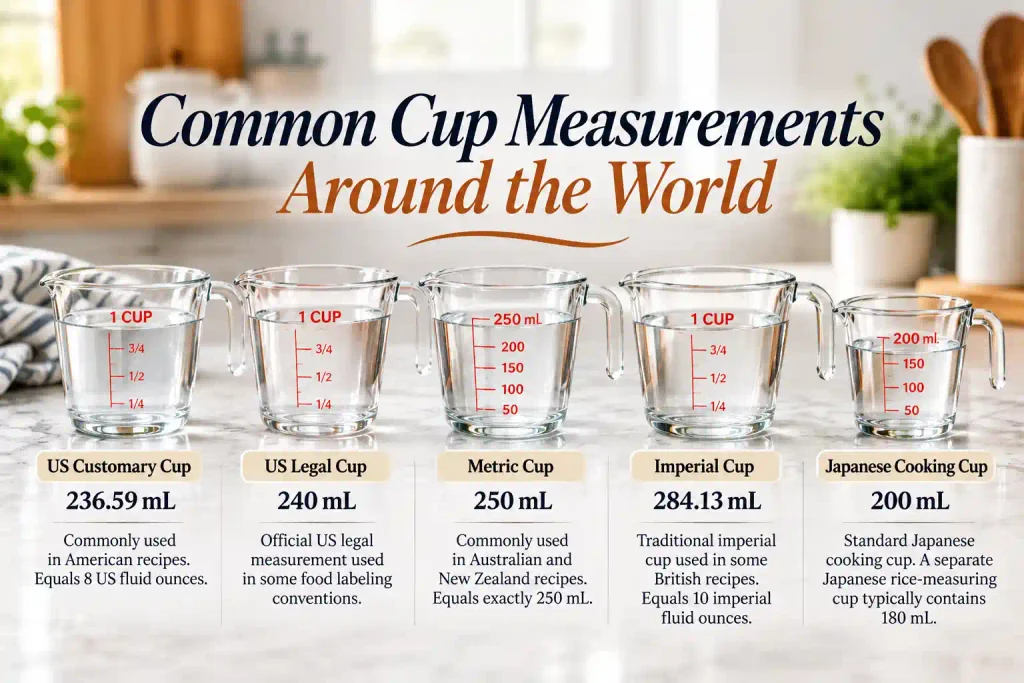
Here is a quick comparison of common cup standards:
| Cup Type | Milliliters in 1 Cup |
| US customary cup | 236.588 mL |
| US legal cup | 240 mL |
| Metric cup | 250 mL |
| Imperial cup | 284.131 mL |
| Japanese standard cooking cup | 200 mL |
For everyday cooking, you can round a US customary cup to 237 mL. However, when following a recipe that uses metric cups, use 250 mL instead.
Quick tip: If a recipe gives measurements in both cups and milliliters, follow the milliliter value when you want the most consistent result.
What Is a Milliliter (mL)?
A milliliter (mL) is a metric unit of volume used to measure how much space a liquid occupies. It is one-thousandth of a liter, meaning 1,000 mL equals 1 liter.
Milliliters are commonly used for measuring water, milk, juice, cooking oil, vinegar, and other liquid ingredients. You will also see them on beverage bottles, food packaging, and measuring jugs.
Here are a few basic measurements:
- 100 mL = 0.1 liter
- 250 mL = 0.25 liter
- 500 mL = 0.5 liter
- 750 mL = 0.75 liter
- 1,000 mL = 1 liter
Unlike cups, milliliters have the same volume everywhere. This makes them useful when following recipes from different countries or measuring ingredients that require accuracy.
What Is a Cup in Cooking Measurements?
A cup is a unit of volume used to measure ingredients in cooking and baking. It can measure both liquids and dry ingredients, including milk, water, flour, sugar, and rice.
However, a cup measures volume, not weight. For example, one cup of flour and one cup of sugar occupy the same volume when measured using the same cup standard, but they do not weigh the same.
Cup measurements also vary by region. In the United States, a customary cup contains approximately 236.59 mL. In Australia, a standard metric cup contains 250 mL.
This difference may seem small, but it matters when a recipe calls for several cups of an ingredient.
For example:
- 4 US customary cups = approximately 946 mL
- 4 metric cups = exactly 1,000 mL
That is a difference of nearly 54 mL.
For reliable results, check which cup standard the recipe uses before measuring.
How to Convert Milliliters to Cups
To convert milliliters to cups, divide the number of milliliters by the volume of one cup in your chosen measurement system.
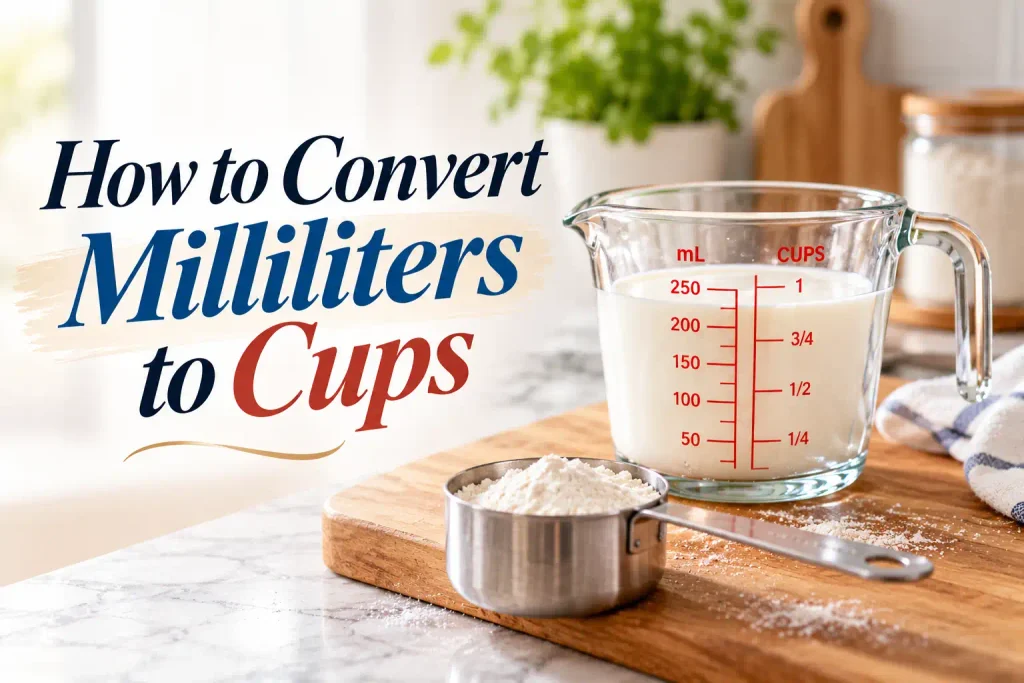
For US customary cups, divide by 236.588. For metric cups, divide by 250.
Milliliters to Cups Conversion Formula
The standard formula is:
Cups = Milliliters ÷ Milliliters per Cup
For US customary measurements:
US Cups = mL ÷ 236.588
For metric measurements:
Metric Cups = mL ÷ 250
You can also use 237 instead of 236.588 for quick US kitchen calculations. The result will be slightly rounded, which is usually acceptable for everyday cooking.
Example 1: How Many Cups Is 250 mL?
To convert 250 mL to US customary cups:
250 ÷ 236.588 = 1.0567 cups
Answer: 250 mL is approximately 1.06 US cups.
For metric cups:
250 ÷ 250 = 1 cup
Answer: 250 mL is exactly 1 metric cup.
This is why a 250 mL measuring cup should not automatically be treated as a US customary cup.
Example 2: How Many Cups Is 500 mL?
Suppose a recipe requires 500 mL of water, but you only have US measuring cups.
Use the formula:
500 ÷ 236.588 = 2.1134 cups
Answer: 500 mL is approximately 2.11 US cups.
Using metric cups:
500 ÷ 250 = 2 cups
Answer: 500 mL equals exactly 2 metric cups.
If you are using US cups and need an accurate 500 mL measurement, a measuring jug with milliliter markings is easier than estimating the extra 0.11 cup.
Example 3: How Many Cups Is 1,000 mL?
One thousand milliliters equals one liter.
For US customary cups:
1,000 ÷ 236.588 = 4.2268 cups
Answer: 1,000 mL is approximately 4.23 US cups.
For metric cups:
1,000 ÷ 250 = 4 cups
Answer: 1,000 mL equals exactly 4 metric cups.
This conversion is useful when measuring larger amounts of water, stock, milk, or other liquids.
mL to Cups Calculator
Convert milliliters to cups using accurate cup standards.
How to Convert Cups Back to Milliliters
To convert cups into milliliters, multiply the number of cups by the volume of one cup in the relevant measurement system.
The formula is:
Milliliters = Cups × Milliliters per Cup
For US customary cups:
mL = Cups × 236.588
For metric cups:
mL = Cups × 250
For example, if a US recipe calls for 2 cups of milk:
2 × 236.588 = 473.176 mL
Answer: 2 US customary cups contain approximately 473 mL.
If the recipe uses metric cups:
2 × 250 = 500 mL
Answer: 2 metric cups contain exactly 500 mL.
The same formulas work for other liquid ingredients because milliliters and cups both measure volume. However, converting the result into grams requires the ingredient’s density.
Also Read: Packaging Symbols Explained
Can You Use 240 mL Instead of 237 mL for One Cup?
Yes, 240 mL is a practical approximation for one US customary cup in many everyday recipes, but it is not the exact customary cup volume.
The US customary cup contains approximately 236.59 mL, while the US legal cup is defined as 240 mL for certain food-labeling measurements.
The difference is about 3.41 mL per cup.
For a single cup of water or milk, this small difference is unlikely to affect most everyday dishes. However, when measuring several cups or following a recipe that requires precise liquid amounts, use the measurement specified in the recipe.
For example:
- 1 US customary cup ≈ 236.59 mL
- 1 US legal cup = 240 mL
- 1 metric cup = 250 mL
These values are close, but they are not interchangeable when exact measurements are required.
Milliliters to Cups Conversion Chart
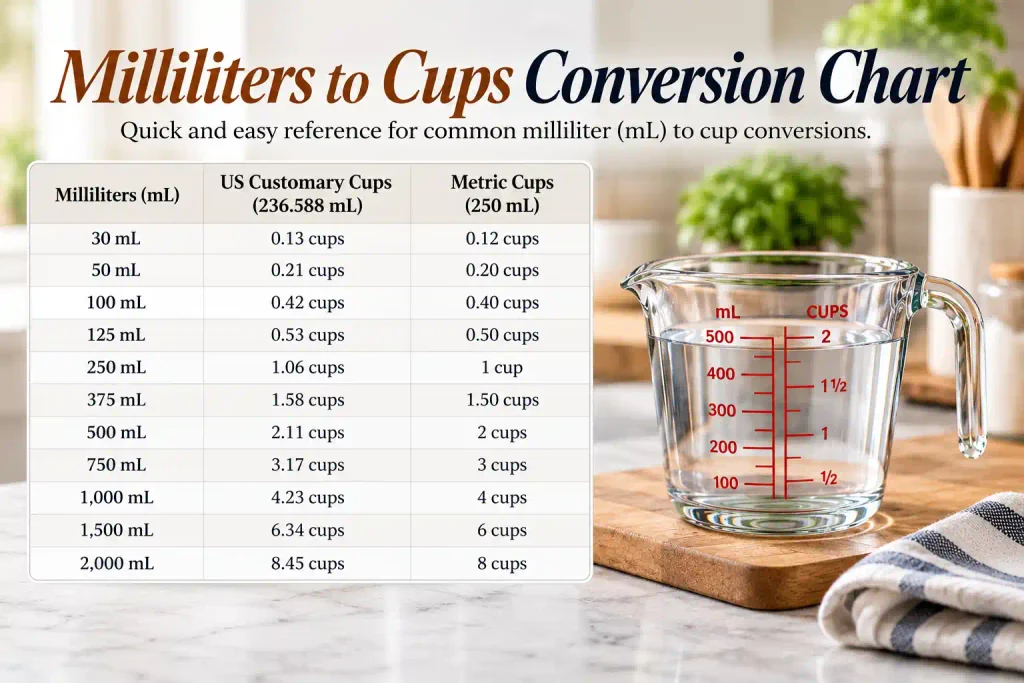
The following mL to cups conversion chart shows common liquid measurements using the US customary cup, which equals approximately 236.588 mL. It helps you convert milliliters to cups without calculating each amount separately.
| Milliliters (mL) | US Customary Cups (Approx.) |
| 25 mL | 0.11 cups |
| 50 mL | 0.21 cups |
| 75 mL | 0.32 cups |
| 100 mL | 0.42 cups |
| 120 mL | 0.51 cups |
| 125 mL | 0.53 cups |
| 150 mL | 0.63 cups |
| 175 mL | 0.74 cups |
| 200 mL | 0.85 cups |
| 225 mL | 0.95 cups |
| 240 mL | 1.01 cups |
| 250 mL | 1.06 cups |
| 300 mL | 1.27 cups |
| 350 mL | 1.48 cups |
| 400 mL | 1.69 cups |
| 450 mL | 1.90 cups |
| 500 mL | 2.11 cups |
| 600 mL | 2.54 cups |
| 700 mL | 2.96 cups |
| 750 mL | 3.17 cups |
| 800 mL | 3.38 cups |
| 900 mL | 3.80 cups |
| 1,000 mL | 4.23 cups |
All cup values are rounded to two decimal places. For exact measurements, divide the milliliter amount by 236.588.
For example, 500 mL equals approximately 2.11 US customary cups, but exactly 2 metric cups. The correct answer depends on the cup standard being used.
Also Read: custom packaging cost
Common Cup Fractions to Milliliters
Many recipes use fractions such as ¼ cup, ½ cup, or ¾ cup instead of decimal measurements. The following chart shows their equivalent volumes in US customary measurements.
| US Cup Measurement | Milliliters (Approx.) |
| ⅛ cup | 29.57 mL |
| ¼ cup | 59.15 mL |
| ⅓ cup | 78.86 mL |
| ½ cup | 118.29 mL |
| ⅔ cup | 157.73 mL |
| ¾ cup | 177.44 mL |
| 1 cup | 236.59 mL |
| 1½ cups | 354.88 mL |
| 2 cups | 473.18 mL |
| 3 cups | 709.76 mL |
| 4 cups | 946.35 mL |
These measurements are useful when a recipe gives cup fractions but your measuring jug displays milliliters.
For instance, if a recipe calls for ½ US cup of milk, measure approximately 118 mL. If it calls for ¾ US cup of water, measure approximately 177 mL.
US Cups vs Metric Cups: What Is the Difference?
The main difference between a US customary cup and a metric cup is their volume. One US customary cup contains approximately 236.59 mL, while one metric cup contains exactly 250 mL.
A metric cup therefore holds about 13.41 mL more than a US customary cup.
Here is how the measurements compare:
| Cup Measurement | US Customary | Metric |
| ¼ cup | 59.15 mL | 62.5 mL |
| ½ cup | 118.29 mL | 125 mL |
| ¾ cup | 177.44 mL | 187.5 mL |
| 1 cup | 236.59 mL | 250 mL |
| 2 cups | 473.18 mL | 500 mL |
| 4 cups | 946.35 mL | 1,000 mL |
This difference matters when following recipes from different countries.
For example, an Australian recipe calling for 4 metric cups of water requires 1,000 mL. Measuring 4 US customary cups instead gives approximately 946 mL, leaving you about 54 mL short.
For soups and everyday cooking, a small difference may not matter much. For cakes, bread, and other baked goods, following the recipe’s intended measurement standard helps maintain consistent results.
Different Cup Measurements Around the World
Cup measurements are not identical worldwide. Countries have developed different measuring standards, so knowing the origin of a recipe can help you choose the correct conversion.
US Customary Cup — 236.59 mL
The US customary cup equals exactly 8 US fluid ounces, or approximately 236.588 mL.
It is commonly used in American cookbooks, household measuring sets, and recipes.
For quick calculations, you can round it to 237 mL.
US Legal Cup — 240 mL
The US legal cup equals exactly 240 mL. It is a defined measurement used in US food-labeling contexts, including certain nutrition-label serving-size references.
It is slightly larger than the US customary cup.
For accurate food-labeling work, follow the applicable labeling rules rather than substituting a household cup measurement.
Metric Cup — 250 mL
A metric cup contains exactly 250 mL. It is the standard cooking cup used in Australia and New Zealand and appears in many metric-based recipes.
Because 4 metric cups equal exactly 1 liter, calculations are straightforward.
Imperial Cup — 284.13 mL
The traditional imperial cup equals 10 imperial fluid ounces, or approximately 284.13 mL.
This measurement may appear in older British recipes, but it should not be assumed to be the standard for every modern UK recipe. Many modern British recipes use grams and millilitres instead.
If you are following an older cookbook, check whether its cup measurements are imperial.
Japanese Cooking Cup — 200 mL
A standard Japanese cooking cup is 200 mL.
It is used in some Japanese recipes, but it should not be confused with a Japanese rice-measuring cup, which commonly holds 180 mL.
For example, 5 standard Japanese cooking cups equal 1 liter, while 5 rice-measuring cups equal 900 mL.
Always check which type of cup the recipe or appliance specifies.
Regional Cup Size Comparison
| Cup Standard | Volume | Typical Context |
| US customary | 236.59 mL | American household recipes |
| US legal | 240 mL | US food-labeling measurements |
| Metric | 250 mL | Australian and New Zealand recipes |
| Traditional imperial | 284.13 mL | Older British measurements |
| Japanese cooking cup | 200 mL | Some Japanese cooking recipes |
| Japanese rice cup | 180 mL | Rice cookers and rice measurements |
Important: A recipe’s country of origin is a useful clue, but the measurement stated by the recipe or manufacturer should always take priority.
How to Measure Milliliters in Cups for Cooking and Baking
The easiest way to measure milliliters using cups is to choose a measuring cup with both mL and cup markings. This allows you to read the amount directly without estimating.
If your measuring cup only shows US cup fractions, you can use the conversion chart to find the nearest practical measurement.
Measuring 100 mL in Cups
100 mL equals approximately 0.42 US cups.
This is slightly more than ⅓ cup and less than ½ cup. For a more accurate measurement, use a measuring jug marked in milliliters.
Measuring 150 mL in Cups
150 mL equals approximately 0.63 US cups.
It is slightly less than ⅔ of a US cup. If your recipe requires accuracy, measure 150 mL directly instead of filling a ⅔-cup measure completely.
Measuring 200 mL in Cups
200 mL equals approximately 0.85 US cups.
That is more than ¾ cup but less than a full US cup. In a standard Japanese cooking cup, however, 200 mL equals exactly 1 cup.
Measuring 240 mL in Cups
240 mL equals approximately 1.01 US customary cups.
It also equals exactly 1 US legal cup. For most everyday American cooking, this amount is close enough to one customary cup to be practical, although the measurements are not identical.
Measuring 250 mL in Cups
250 mL equals approximately 1.06 US customary cups or exactly 1 metric cup.
If your recipe uses metric measurements, fill a standard 250 mL metric measuring cup once.
Measuring 500 mL in Cups
500 mL equals approximately 2.11 US customary cups or exactly 2 metric cups.
If you are measuring 500 mL for a recipe, a metric measuring jug is the simplest option.
Measuring 750 mL in Cups
750 mL equals approximately 3.17 US customary cups or exactly 3 metric cups.
This measurement is common when working with larger liquid quantities, such as stock, water, or bottled beverages.
Measuring 1,000 mL in Cups
1,000 mL equals approximately 4.23 US customary cups or exactly 4 metric cups.
Since 1,000 mL also equals 1 liter, a one-liter measuring jug can make this measurement easier.
Why Accurate mL to Cups Conversion Matters
Accurate conversion helps you use the amount of liquid a recipe actually requires. This is especially important when the balance between wet and dry ingredients affects the finished dish.
In baking: Too much or too little liquid can change the consistency of cake batter, bread dough, or pastry mixtures. Following the correct measurements helps maintain the intended texture.
In cooking: Soups, sauces, and dressings are often more flexible, but correct liquid measurements still help you control thickness and flavor.
In international recipes: Using the wrong cup standard can create larger differences when a recipe requires several cups of liquid.
In food preparation: Measuring ingredients consistently makes it easier to repeat a recipe and get similar results each time.
For the best results, use the original milliliter measurement whenever it is available. Converting to cups is useful when your measuring tools do not show metric units, but direct measurement avoids unnecessary rounding.
Tips for Measuring Liquids Accurately
To measure liquids accurately, use a measuring cup with clear markings, place it on a level surface, and read the liquid at eye level. Even when your mL to cups conversion is correct, poor measuring technique can change the amount you pour.
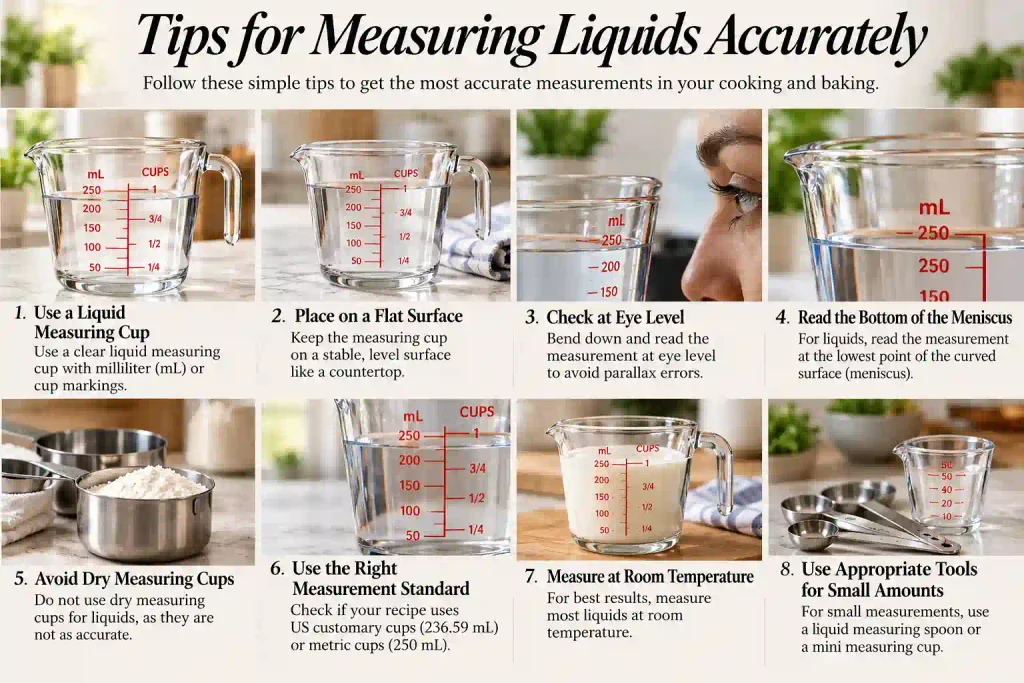
Follow these simple tips for better results.
1. Use a Liquid Measuring Cup
Choose a transparent measuring jug with milliliters and cup markings. Liquid measuring cups usually have a pouring spout and extra space above the highest measurement line to prevent spills.
For small quantities, use measuring spoons or a suitable graduated measuring tool.
2. Keep the Measuring Cup on a Flat Surface
Place the measuring cup on a level countertop before filling it. Holding it in your hand can tilt the cup and make the liquid level difficult to judge.
3. Check the Measurement at Eye Level
Look directly at the measurement line rather than viewing it from above. For water and similar liquids, read the bottom of the curved liquid surface, called the meniscus.
This helps prevent errors caused by viewing the markings from the wrong angle.
4. Use the Correct Cup Standard
Before converting milliliters to cups, check whether your recipe uses US customary or metric measurements.
Remember:
- 1 US customary cup ≈ 236.59 mL
- 1 US legal cup = 240 mL
- 1 metric cup = 250 mL
Using the wrong cup standard can change the amount of liquid, especially when measuring several cups.
5. Measure Small Amounts Carefully
For small amounts of liquid, measuring spoons or a graduated measuring tool are usually easier to use than a large measuring jug.
If a recipe specifies an exact amount in milliliters, use a tool with markings fine enough to measure that quantity.
6. Follow the Recipe’s Original Measurements
If a recipe provides both cups and milliliters, use its stated milliliter measurement when possible. This avoids small differences caused by rounding or regional cup sizes.
For recipes requiring high precision, especially baking, use the measurement method recommended by the recipe author.
7. Measure Liquids at Room Temperature
Measure liquids at room temperature for consistent results, unless your recipe specifies otherwise. Temperature changes can slightly affect liquid volume.
8. Use Appropriate Tools for Small Amounts
Use measuring spoons or mini measuring cups for small liquid quantities. These tools provide more accurate measurements than large measuring jugs.
Also Read: How Much Is a Quarter of Weed?
Common Mistakes When Converting Milliliters to Cups
The most common mistakes are using the wrong cup size, confusing volume with weight, and rounding measurements too much. Avoiding these errors makes cooking and baking more consistent.
Confusing Milliliters With Grams
Milliliters measure volume, while grams measure mass. They cannot be converted directly without knowing the ingredient’s density.
For example, 100 mL of water has a mass close to 100 grams under ordinary kitchen conditions, but 100 mL of cooking oil weighs less because oil is less dense.
Always use a volume conversion when changing milliliters into cups.
Assuming Every Cup Equals 250 mL
A 250 mL cup is a metric cup, not a US customary cup.
For example, 500 mL equals exactly 2 metric cups but approximately 2.11 US customary cups.
Check your measuring cup before using it for an international recipe.
Rounding Measurements Too Early
Rounding 236.588 mL to 237 mL is usually acceptable for everyday cooking. However, using an overly rough estimate repeatedly can create noticeable differences.
For precise conversions, calculate using the defined cup volume and round only the final result.
Using the Wrong Measuring Tool
Dry measuring cups are designed to be filled to the rim and leveled, while liquid measuring cups have measurement markings below the rim.
Both measure volume, but using the tool designed for the ingredient makes measuring easier and helps reduce spills or inconsistent filling.
Estimating Liquid Amounts by Sight
Guessing how much liquid is in a cup can lead to overfilling or underfilling.
When a recipe specifies 150 mL, use a marked measuring tool rather than estimating the amount in an ordinary drinking cup.
Conclusion
Converting milliliters to cups is easy when you know which cup standard to use. For US customary cups, divide the milliliter amount by 236.588. For metric cups, divide by 250.
Remember that 1 US customary cup is approximately 237 mL, while 1 metric cup is exactly 250 mL. This small difference becomes more important when measuring larger quantities or following recipes that require precise amounts.
Keep the conversion chart handy for common measurements, check the cup standard in unfamiliar recipes, and use a measuring jug with milliliter markings whenever possible. These simple habits will help you measure ingredients accurately and get more consistent cooking and baking results. For more practical guides on measurements, food storage and packaging, you can explore Search Packaging.
Frequently Asked Questions About Milliliters to Cups
1. How Many Milliliters Are in One Cup?
One US customary cup contains approximately 236.59 mL, while one metric cup contains exactly 250 mL. The correct amount depends on the cup standard used in your recipe.
2. How Many Cups Is 250 mL?
250 mL equals approximately 1.06 US customary cups or exactly 1 metric cup. If you are following an Australian or New Zealand recipe that uses metric cups, 250 mL is one full cup.
3. Is 240 mL Equal to 1 Cup?
Yes, 240 mL equals exactly one US legal cup. It is also a close approximation of one US customary cup, which contains approximately 236.59 mL.
4. Is 500 mL Equal to 2 Cups?
500 mL equals exactly 2 metric cups. In US customary measurements, it equals approximately 2.11 cups.
5. How Many Cups Is 1 Liter?
One liter contains 1,000 mL, which equals approximately 4.23 US customary cups or exactly 4 metric cups.
6. How Do You Convert mL to Cups Without a Calculator?
For a quick estimate, divide the milliliter amount by 240 for US cups or by 250 for metric cups.
For example, 480 mL divided by 240 gives approximately 2 US cups. This is a convenient estimate, not an exact US customary conversion.
7. What Is the Difference Between US and Metric Cups?
A US customary cup contains approximately 236.59 mL, while a metric cup contains exactly 250 mL. A metric cup holds about 13.41 mL more.
8. How Many Cups Is 100 mL?
100 mL equals approximately 0.42 US customary cups or 0.4 metric cups.
9. How Many Cups Is 200 mL?
200 mL equals approximately 0.85 US customary cups or 0.8 metric cups. It also equals one standard Japanese cooking cup, although Japanese rice-measuring cups commonly hold 180 mL.
10. How Many Cups Is 750 mL?
750 mL equals approximately 3.17 US customary cups or exactly 3 metric cups.
11. Are Liquid and Dry Measuring Cups the Same?
Both measure volume, but they are designed differently. Liquid measuring cups usually have pouring spouts and marked measurement lines, while dry measuring cups are filled to the top and leveled. For liquids, a marked liquid measuring cup is generally more convenient.
12. Does the mL to Cups Formula Work for Every Liquid?
Yes. The formula works for water, milk, oil, juice, vinegar, and other liquids because both milliliters and cups measure volume. However, converting those volumes into grams requires the density of the specific liquid.