
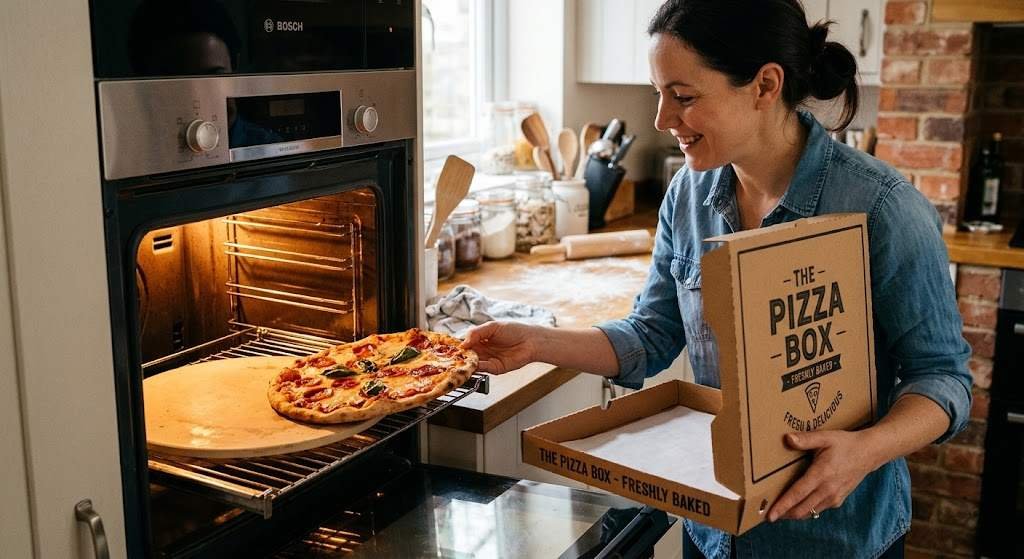
No, you should not put a pizza box in the oven. Most pizza boxes are made from corrugated cardboard, which can scorch, smoke or catch fire when exposed to oven heat. Printing inks, adhesives and grease-resistant coatings are also not necessarily designed for oven use.
Even at low temperatures, a standard cardboard pizza box is not an oven-safe container. If your pizza has gone cold, remove it from the box and use a baking sheet, pizza stone or oven-safe skillet instead.
This guide explains what happens when cardboard is heated, why pizza boxes are not oven safe, and how to reheat or keep pizza warm without creating a fire hazard.
Can You Put Cardboard in the Oven?
No. Ordinary cardboard should not go in a conventional oven, toaster oven or air fryer unless the product is specifically designed and labelled for that appliance and use.
Cardboard is a paper-based material. It is useful for packaging because it is lightweight, affordable and easy to shape, but it is combustible. Ovens also have heating elements and surfaces that can become much hotter than the temperature shown on the control panel. A cardboard box touching one of these surfaces may scorch or ignite. Some frozen food products include trays or sleeves with specific heating instructions. Those are exceptions designed for particular uses, not evidence that regular pizza delivery boxes are oven safe.
What Happens If You Put a Pizza Box in the Oven?
A pizza box exposed to oven heat may develop brown patches, warp, release an unpleasant smell, produce smoke or ignite. The result depends on the box materials, oven temperature, heating method, exposure time and distance from heating elements.
1. Cardboard Can Scorch or Catch Fire
A standard pizza box is combustible. As it heats, the paper fibres may dry further, discolor and begin to break down. With sufficient heat exposure, the cardboard can ignite.
A pizza box fire hazard exists even if the box has previously held hot pizza without any damage. Receiving heat from a freshly baked pizza is different from being exposed to an oven’s heating elements. The safest choice is to keep cardboard out of the oven entirely.
2. Grease-Soaked Cardboard Adds Another Risk
Pizza boxes often absorb oil from cheese, toppings and crust. Grease-soaked cardboard should not be used as a heating surface. Accumulated grease can contribute to smoke and combustion, particularly if the packaging is exposed to excessive heat.
A visibly oily box is also unsuitable for repeated food use. For reheating, transfer the pizza onto clean, oven-safe cookware instead of using its original packaging.
3. Printing Inks May Not Be Suitable for Heating
Many pizza boxes feature colourful logos, promotional messages and printed graphics. These printing inks are chosen for packaging applications, not necessarily for exposure to cooking temperatures.
Heating can affect inks and other printed layers. Without manufacturer testing and specific oven-use instructions, their behaviour at elevated temperatures cannot be assumed safe. An unprinted cardboard box is not a safe alternative because the cardboard itself remains combustible.
4. Adhesives and Protective Coatings Can Be Affected
Pizza box materials may include packaging adhesives, moisture barriers and grease-resistant protective coatings. These materials help the box maintain its shape, resist oil and protect the food during delivery.
However, food-contact suitability and oven suitability are different requirements. A coating designed to tolerate warm food may not be tested for prolonged exposure to oven temperatures.
The same applies to adhesives holding the packaging together. Excessive heating may damage the material or affect its performance. This is particularly important when packaging products that require careful handling, including cannabis products, where understanding different quantities can also help provide useful product-related information.
What Temperature Can Cardboard Withstand in an Oven?
There is no universal safe oven temperature for ordinary cardboard pizza boxes. Online articles frequently mention cardboard ignition temperatures around 400–450°F (204–232°C). These are approximate figures associated with certain materials or testing conditions, not an approved heating range for pizza packaging.
Actual ignition behaviour depends on factors such as material composition, moisture, airflow, exposure duration and proximity to hot surfaces. Cardboard can also scorch or smoke before it ignites. The temperature selected on an oven does not represent the temperature of every heating element or surface inside it.
Does a Low Oven Temperature Make Cardboard Safe?
No. Setting an oven to 150°F, 170°F or 200°F does not automatically make a cardboard pizza box safe to use. Although a lower setting may reduce some risks, it does not establish that the material, printing inks, adhesives and coatings are suitable for oven exposure.
The practical rule is simple: If the box does not explicitly state that it is oven safe and provide heating instructions, keep it out of the oven.
Are Pizza Boxes Oven Safe? Understanding Their Materials
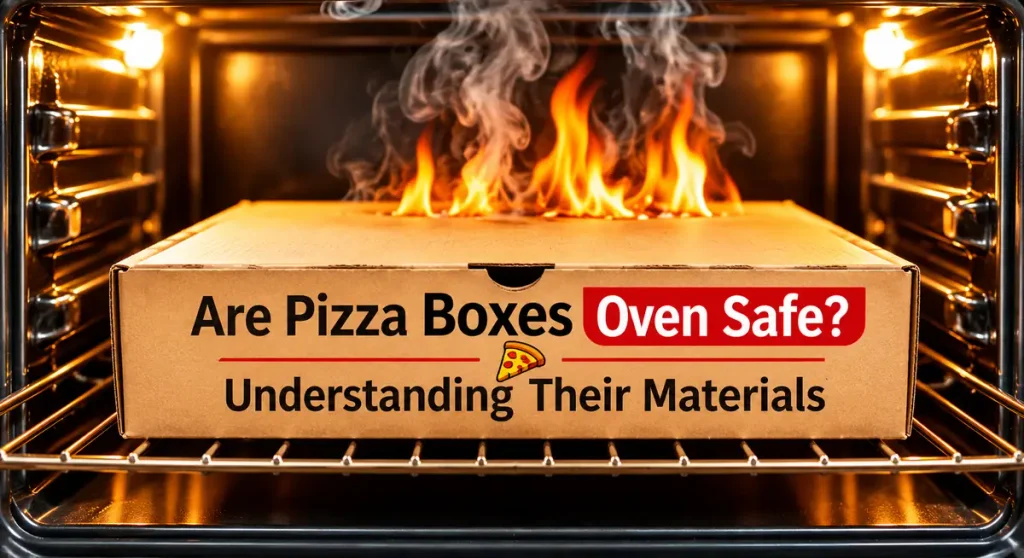
Most takeaway pizza boxes are designed for carrying and protecting food, not cooking it. The construction helps explain why.
Corrugated Cardboard
Corrugated cardboard usually contains two flat paper layers separated by a fluted layer. The fluted structure creates air spaces that help provide cushioning, rigidity and some insulation. This makes a corrugated board useful for transporting hot pizza. However, it does not make the material fireproof.
For example, custom corrugated pizza boxes are designed to protect pizza during delivery, reduce handling damage and support heat retention. Similarly, choosing the right cereal box dimensions helps ensure that packaging fits the product properly. Those packaging benefits should not be confused with approval for oven use.
Kraft Paperboard
Kraft pizza boxes are often chosen for their natural appearance and packaging strength. Although kraft paperboard can be suitable for food packaging when properly specified, it remains a paper-based material. A brown kraft box is not safer for oven reheating simply because it looks less processed.
Coated and Printed Pizza Boxes
Some pizza boxes use protective surface treatments to improve resistance to grease and moisture. Others include decorative printing or specialty finishes. These features may improve packaging performance during transport, but they do not automatically provide heat resistance suitable for cooking. For food businesses comparing packaging options, material thickness, ventilation and grease resistance should be selected according to the intended use.
Can You Put a Pizza Box in the Oven to Keep It Warm?
No. A cardboard pizza box should not be placed in an oven just to keep pizza warm. This applies even if you intend to use the oven for only a few minutes or leave it switched off after preheating. Residual heat, hot surfaces and accidental activation can create unnecessary risks. If your pizza needs to stay warm before serving, transfer it to an oven-safe tray and use an appropriate warming method. If the pizza will not be eaten soon, refrigerate it promptly rather than leaving it sitting at room temperature.
Can You Reheat Pizza in the Box?
No. Remove the pizza from its cardboard box before reheating it. Putting the entire box into the oven can create a fire hazard and may affect the food’s smell or quality. The same caution applies to reheating standard pizza boxes in a microwave. Ordinary cardboard delivery packaging may contain materials or components that are not suitable for microwave heating.
Instead, use a microwave-safe plate or an appropriate oven-safe surface. For food safety, the USDA recommends reheating leftovers to an internal temperature of 165°F (74°C). Use a food thermometer to check that the pizza is heated thoroughly.
Safe Ways to Reheat Pizza Without the Cardboard Box
The best reheating method depends on the number of slices, available equipment and whether you prefer a crispy pizza crust or a softer texture.
1. Reheat Pizza on a Baking Sheet
A metal baking sheet is a convenient choice for reheating several slices.
Steps:
- Preheat your oven to 350°F (177°C).
- Remove the pizza from its packaging.
- Arrange the slices on a clean, oven-safe baking sheet.
- Heat until the pizza is thoroughly warmed.
- Check that the leftovers reach an internal temperature of 165°F (74°C).
The exact reheating time will depend on slice thickness, toppings, starting temperature and oven performance. A baking sheet provides a stable surface and makes the pizza easier to handle.
2. Use a Cast Iron Skillet for a Crispier Crust
A cast iron skillet can help restore the texture of leftover pizza. Its cooking surface transfers heat directly to the bottom crust, making it particularly useful when reheating one or two slices.
Steps:
- Place a slice in a clean cast iron skillet.
- Heat over medium-low heat.
- Allow the crust to warm and crisp.
- If necessary, cover briefly with a suitable lid to help warm the toppings.
- Continue until the pizza is thoroughly heated to 165°F (74°C).
Avoid overheating the skillet, which can burn the crust before the toppings become hot enough.
3. Reheat Pizza on a Pizza Stone
A pizza stone can help produce a firmer, crispier base. It is most useful when reheating several slices or when you want a texture closer to freshly baked pizza. Follow the stone manufacturer’s preheating and handling instructions. Place the pizza directly on the approved cooking surface and heat thoroughly. Do not put the cardboard box beneath the pizza or use cardboard to transfer the pizza onto a hot stone.
4. Use a Microwave-Safe Plate
A microwave is a practical option when you need to reheat a slice quickly.
Steps:
- Transfer the pizza to a microwave-safe plate.
- Cover it with a microwave-safe cover if appropriate.
- Heat in short intervals, following your microwave’s instructions.
- Allow the food to stand briefly for more even heating.
- Check that it reaches 165°F (74°C) throughout.
Microwaving may leave the crust softer than oven or skillet reheating, but it is often the most convenient method.
5. Use an Air Fryer
An air fryer can reheat small portions and help restore a crisp crust. Remove all cardboard packaging before placing pizza in the basket. Follow the appliance manufacturer’s reheating instructions, avoid overcrowding and ensure the pizza reaches a safe internal temperature.
Which Pizza Reheating Method Works Best?
| Method | Suitable equipment | Main advantage | Consideration |
| Conventional oven | Baking sheet | Reheats several slices | Requires preheating |
| Stovetop | Cast iron skillet | Helps crisp the bottom crust | Needs careful heat control |
| Pizza stone | Oven-safe pizza stone | Produces a firmer base | Requires manufacturer-approved handling |
| Microwave | Microwave-safe plate | Quick and convenient | Crust may become soft |
| Air fryer | Approved air fryer basket | Convenient for small portions | Basket size limits capacity |
Whichever method you choose, remove the original packaging and heat leftover pizza thoroughly.
Can You Use Aluminum Foil or Parchment Paper?
Aluminum foil can be used with compatible oven-safe cookware, following the oven manufacturer’s instructions. Do not wrap a cardboard pizza box in aluminum foil and place it in the oven. Foil does not turn combustible packaging into oven-safe cookware.
Parchment paper can also be useful for reheating pizza, but only within its manufacturer’s stated temperature limit. Keep it away from exposed heating elements and avoid using it under the broiler unless specifically approved. For most households, a plain metal baking sheet is the simplest option.
How to Keep Pizza Warm Without an Oven
If you are waiting for guests or arranging a takeaway meal, there are several ways to help pizza retain heat without putting cardboard in an oven.
Keep the Delivery Box Closed Briefly
If you plan to eat shortly after delivery, keeping the pizza in its closed box can slow heat loss. The box’s insulating structure helps limit rapid cooling, although it cannot maintain a safe serving temperature indefinitely.
Use an Insulated Pizza Delivery Bag
Insulated delivery bags help reduce heat loss during transport. They are especially useful for restaurants, catering businesses and delivery services handling multiple orders. However, an insulated bag is not a substitute for properly controlled hot-holding equipment when food must be kept hot for an extended period.
Use an Approved Food Warmer
An electric warming tray or commercial food warmer may be suitable when used according to its instructions. Transfer pizza to an approved food-contact surface and keep hot-held food at 140°F (60°C) or above. Check the appliance’s performance rather than assuming it maintains a safe temperature.
Avoid Leaving Pizza Out Too Long
Pizza is perishable, especially when it contains cheese, meat or other refrigerated toppings. The USDA advises refrigerating perishable leftovers within two hours, or within one hour if the surrounding temperature exceeds 90°F (32°C). Do not leave pizza on the counter overnight and assume reheating will make it safe.
How Long Can You Store Leftover Pizza?
Refrigerated leftover pizza should generally be eaten within three to four days. Transfer leftover slices to a clean, covered container or wrap them appropriately before refrigeration.
Keep the refrigerator at 40°F (4°C) or below. If you do not plan to eat the leftovers within that period, freeze them for longer storage. For reheating, heat the pizza to 165°F (74°C) as recommended by USDA food-safety guidance.
Remember that a pizza box protects food during delivery; it is not necessarily the best container for airtight refrigerated storage.
What Should You Do If a Pizza Box Starts Smoking in the Oven?
If a pizza box begins smoking, switch off the oven if you can do so safely. Do not reach inside to pull out a smoking or burning box.
If a fire starts inside the oven:
- Turn off the heat if it is safe to do so.
- Keep the oven door closed.
- Do not throw water onto burning grease or attempt to carry a burning box outside.
- Evacuate and call emergency services if the fire persists, spreads or you cannot safely control the situation.
The U.S. Fire Administration advises keeping the oven door closed during an oven fire and calling emergency services when necessary. Once the situation is safe and the appliance has cooled, have the oven inspected if it has been exposed to flames or significant smoke damage.
How Pizza Box Design Helps Keep Food Warm During Delivery
A good pizza box is designed to balance heat retention, ventilation and structural strength. The fluted construction of corrugated packaging slows heat transfer, while suitable ventilation openings allow some steam to escape.
Without ventilation, excess moisture can collect inside the box and soften the crust. A correctly sized box also prevents excessive movement during transport. Restaurants selecting packaging should consider these features together rather than focusing only on board thickness.
Important: Heat retention during delivery does not mean the packaging is suitable for oven reheating.
Final Verdict: Should Pizza Boxes Go in the Oven?
No. Standard cardboard pizza boxes should stay out of conventional ovens, toaster ovens and air fryers. Cardboard is combustible, and the inks, adhesives, coatings and grease found in used pizza boxes may introduce additional risks when heated. There is no reliable universal oven temperature at which an ordinary delivery box becomes safe to use.
For reheating, remove the pizza from its packaging and choose an oven-safe baking sheet, skillet, pizza stone or microwave-safe plate. To keep pizza warm, use suitable insulated transport equipment or approved food-warming appliances while following safe food-temperature guidance. The goal is simple: keep the pizza warm and enjoyable without putting combustible packaging near an oven’s heating elements. For more packaging-related information and practical guides, explore the Search Packaging.
Frequently Asked Questions
1. Can you put a frozen pizza directly on an oven rack?
Yes, if the frozen pizza’s cooking instructions permit it. Some frozen pizzas are designed to cook directly on an oven rack, while others require a baking sheet or tray. Always follow the product instructions and remove packaging unless a specific component is approved for oven use.
2. Is the small plastic pizza saver oven safe?
No. The small plastic support placed in the middle of some takeaway pizzas is usually intended to prevent the box lid from touching the toppings. Remove it before reheating unless the manufacturer explicitly identifies it as oven safe.
3. Can you recycle a pizza box with grease stains?
In many recycling programmes, pizza boxes with ordinary grease stains are accepted, but local rules vary. Remove leftover food, cheese and other debris before recycling. Check your municipal recycling programme for instructions on heavily soiled cardboard.
4. Can you refrigerate pizza in its original cardboard box?
You can place pizza in the refrigerator in its box temporarily if it is still clean and fits safely, but a covered food-storage container is usually better. It helps protect the pizza from drying out and reduces exposure to other refrigerated foods.
5. Do pizza boxes marked microwave-safe also work in ovens?
No. Microwave-safe and oven-safe are different designations. A package approved for microwave heating should not be used in a conventional oven unless its instructions specifically permit that use.
6. Can you put a pizza box on top of a hot stove?
No. Keep pizza boxes away from active burners and hot stovetop surfaces. Food packaging is combustible and can catch fire if placed too close to a heat source.