

A standard pack of cigarettes in the United States holds 20 cigarettes. A standard carton holds 10 packs, which makes 200 cigarettes in total.
That is the short answer to how many cigarettes come in a pack. The full answer depends on the country, the brand, and the type of pack. Some markets sell packs of 25, a few still sell packs of 10, and the rules behind these numbers are different in every region.
Whether you call them cigarettes, cigs, or smokes, this guide explains all of it in plain words: the pack count in the US, why the number is 20, pack sizes around the world, cartons, pack types, cigarette lengths, and prices.
Quick Answer: How Many Cigarettes in a Pack?
- One standard pack: 20 cigarettes
- One carton: 10 packs, or 200 cigarettes
- Smallest pack allowed in the US: 20 cigarettes
- Other pack sizes still sold in some countries: 10 and 25
- Most common pack styles: hard pack and soft pack
How Many Cigarettes Are in a Pack in the US?
Every major brand sold in the US comes in a pack of 20. This is not only a habit of the market. It is also the law.
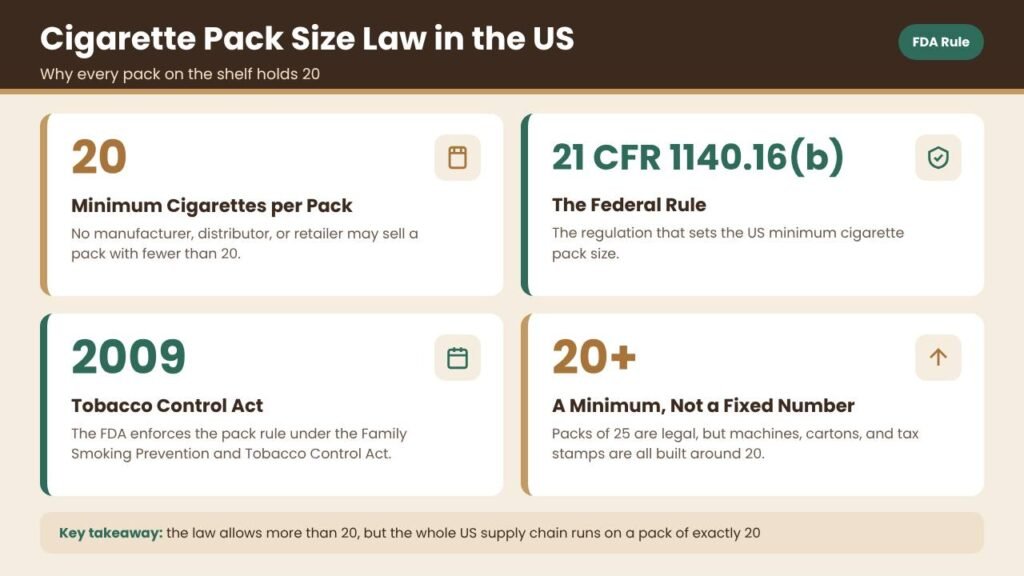
A federal rule, 21 CFR 1140.16(b), says that no manufacturer, distributor, or retailer may sell a cigarette pack that contains fewer than 20 cigarettes. The FDA enforces this rule under the Family Smoking Prevention and Tobacco Control Act of 2009.
One point is often explained the wrong way. The law sets a minimum, not a fixed number. A pack can legally hold more than 20 cigarettes, and packs of 25 have been sold in America in the past. Today almost every pack on the shelf holds exactly 20, because machines, cartons, tax stamps, and pricing are all built around that count.
Why Are There 20 Cigarettes in a Pack?
There is no single reason. The number 20 became the standard because it worked well for everyone in the supply chain.
It fits the pack neatly. Twenty cigarettes sit in three rows of 7, 6, and 7. This layout fills a small rectangular box with almost no empty space, so the cigarettes do not move around or get crushed.
It makes tax simple. Cigarette taxes in the US are charged per pack of 20. One fixed count makes it easy to apply tax stamps and compare prices.
It suits daily use. For decades, a pack of 20 was roughly a one day supply for a regular smoker. That made it a practical unit to buy and carry.
The law locked it in. Smaller packs cost less, which makes them easier for young people to buy. Many governments set 20 as the minimum pack size for this reason, and the market followed.
Are There Packs With Fewer or More Than 20 Cigarettes?
Yes, but it depends on where you are. Each country sets its own minimum cigarette pack size, and some also set a maximum. That is why a pack size that is normal in one market can be illegal in another.
Half pack (10 cigarettes). A pack of 10 is called a half pack. It cannot be sold in the US, the UK, or the European Union because of minimum pack size laws. It is still sold in some countries in Asia and Africa.
Pack of 25. This size is common in Canada. It is rarely seen in America now.
Pack of 30 or more. Large value packs were sold in a few markets, mainly Australia. As explained below, Australia has now stopped them.
Cigarette Pack Sizes by Country
The answer to how many cigarettes in a pack changes from one country to the next. The number is decided by national law first and market habit second. Here is how the main markets compare.
| Country or region | Cigarettes per pack | What the rule says |
| United States | 20 | Minimum of 20 per pack under federal law |
| United Kingdom | 20 | Minimum of 20 per pack, so packs of 10 are no longer sold |
| European Union | 20 | Minimum of 20 per pack under the Tobacco Products Directive |
| Canada | 20 or 25 | Plain packaging, and every pack must be a slide and shell box |
| Australia | 20 | Since July 1, 2025, every pack must hold exactly 20 |
| Japan and South Korea | 20 | 20 is the market standard |
| India and parts of Africa | 10 or 20 | Packs of 10 are still common |
Australia is the change most guides miss. For years it was known for packs of 25, 30, and even larger. Under its new tobacco laws, every cigarette pack sold there must now hold 20 sticks, and every carton must hold 10 packs.
How Many Cigarettes Are in a Carton?
A standard carton holds 10 packs. With 20 cigarettes in each pack, that comes to 200 cigarettes per carton. So if you are asking how many packs of cigarettes are in a carton, the answer is 10.
A carton is the outer cardboard box that keeps the packs together for shipping, storage, and bulk sale. Here is how the larger units add up:
- 1 pack: 20 cigarettes
- 1 carton: 10 packs, or 200 cigarettes
- 1 sleeve: another name for a carton, so also 200 cigarettes
- 1 master case: usually 50 cartons, or 10,000 cigarettes. Some manufacturers pack 60 cartons, or 12,000 cigarettes.
Does the Carton Count Ever Change?
The count of 200 stays the same in most markets. What changes is the cigarette carton size and shape.
- Cartons for 100s still hold 10 packs, but the box is taller because the cigarettes are longer.
- Slim cartons hold 10 slim packs in a narrower box.
- Half cartons hold 5 packs, or 100 cigarettes. Some brands use them for travel retail and smaller purchases.
- In Canada, a carton also totals 200 cigarettes, so packs of 25 come 8 to a carton.
How Many Cigarettes Are in a Pack by Brand?
In the US market, the brand does not change the count. Every major brand packs 20 cigarettes. Only the length of the cigarette and the height of the box change.
| Brand | Cigarettes per pack | Common sizes |
| Marlboro | 20 | King size, 100s, 72s |
| Newport | 20 | King size, 100s |
| Camel | 20 | King size, 100s |
| American Spirit | 20 | King size |
| Winston | 20 | King size, 100s |
| Pall Mall | 20 | King size, 100s |
| Kool | 20 | King size, 100s |
| L&M | 20 | King size, 100s |
| Virginia Slims | 20 | 100s, 120s |
The same count applies to other well known names such as Lucky Strike, Parliament, and Basic.
A common mix up is the term 100s. A pack of Marlboro 100s does not hold 100 cigarettes. It holds 20 cigarettes that are each 100 mm long.
Hard Pack vs Soft Pack: What Is the Difference?

Cigarette packs come in two basic builds, the soft pack and the hard pack. The main difference between them is the material, which decides how well the pack protects the cigarettes and how much it costs to make. The style you see on the shelf usually depends on the brand and its price range.
Soft pack. A soft pack is made of thin paper with a foil lining and a clear film wrap. It is light, flexible, and cheaper to produce. The weak point is protection, because the pack bends in a pocket and the cigarettes can get crushed. You open it by tearing a corner at the top. Camel, Pall Mall, and Lucky Strike are classic examples of brands sold in soft packs.
Hard pack. A hard pack is made of stiff paperboard. It keeps its shape under pressure, protects the cigarettes better, and gives more flat space for printing and health warnings. It costs a little more to make, but it is the leading format in most markets today.
Both builds hold the same 20 cigarettes.
Cigarette Box Styles
Within these two builds, brands use several box styles. Each style opens in a different way and gives the pack a different look and feel in the hand. The choice usually depends on the price range of the brand, the size of the cigarette, and the packaging rules of the country where it is sold.
Flip top box. This is the most common style in the world. It has a hinged lid that opens and closes at the top. Marlboro made it popular in the mid 1950s, and most hard packs still use it.
Slide and shell box. An inner tray slides out of an outer shell, like a small drawer. It has a premium feel, and Canada requires this style for every cigarette pack.
Tuck end box. Flaps at the top and bottom tuck into the box to close it. It is simple, low cost, and easy to produce in large numbers.
Slim pack. A narrow, compact box made for slim cigarettes. It takes less pocket space and has a sleek look.
Shoulder neck box. A rigid two piece box used for luxury and limited edition cigarettes. It often holds fewer than 20, so it is used in markets where that is allowed, or for gift sets.
Cigarette Lengths: King Size vs 100s vs 120s
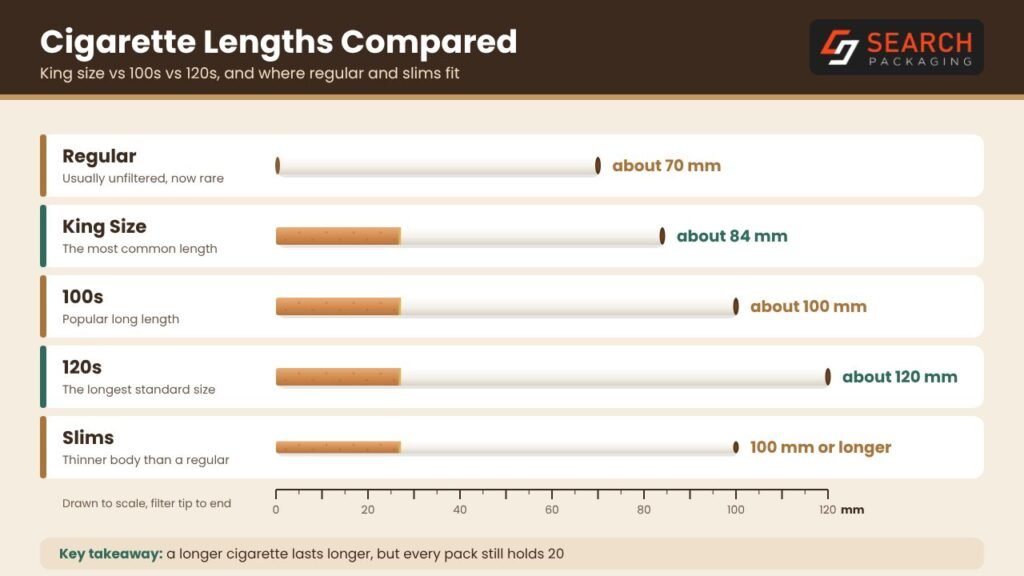
Cigarettes come in a few standard lengths, and the pack is built around them. The length is measured in millimeters from the tip of the filter to the end of the cigarette. The names you see on a pack, such as king size, 100s, and 120s, simply tell you which length is inside.
- Regular: about 70 mm, usually unfiltered, now rare
- King size: about 84 mm, the most common length
- 100s: about 100 mm
- 120s: about 120 mm, the longest standard size
- Slims: usually 100 mm or longer, with a thinner body than a regular cigarette
A longer cigarette usually holds more tobacco, so the length changes how long it lasts, not how many come in the pack.
Cigarette Pack Dimensions
A king size pack of 20 measures roughly 3.4 inches tall, 2.2 inches wide, and 0.9 inches deep. A pack of 100s has about the same width and depth but stands close to 4 inches tall. Slim packs are narrower and thinner.
Exact cigarette box dimensions differ slightly from brand to brand and from one packaging supplier to another, because board thickness and box style both change the outside size.
How Do Box Dimensions Affect a Brand?
Size changes how a pack is carried, opened, and seen. A small change in height, width, or depth can make a pack feel easier to use or help it look different from the packs next to it. This is why brands plan the dimensions of the box as carefully as the design printed on it.
- Easy to carry. A compact pack fits a shirt pocket or a small bag.
- Easy to open. Flip top and slide and shell boxes give quick access with one hand.
- Shelf look. Slim and tall packs stand out next to standard packs, which is why brands use them to set a product apart.
- Printing space. A larger front panel leaves more room for branding and required warnings.
What Decides the Number of Cigarettes in a Pack?
Four things shape the final count. No brand picks the number on its own, because the law, the tax system, and the cost of production all push in the same direction. Together they explain why 20 became the standard and why it has stayed that way for so long.
Government rules. Minimum pack size laws set the lowest number allowed, and some countries now fix the exact number.
Taxes. When tax is charged per pack of 20, there is little reason for a brand to use any other count.
Production cost. A bigger pack needs more board, foil, and film. It costs more to make but can lower the cost per cigarette.
Buyer habits. In markets where smaller packs are legal, they attract light smokers and buyers on a budget. Larger packs attract regular smokers who want fewer trips to the store.
How Much Is a Pack of Cigarettes in the US?
The average price of a pack of cigarettes in the US is about $10.15 as of January 2026. That works out to roughly 51 cents per cigarette.
The price changes a lot from state to state. New York is the most expensive at about $14.83 per pack. The District of Columbia, Rhode Island, Connecticut, and Maryland also average above $13. Missouri is the cheapest at about $8.01 per pack, and Alabama, South Carolina, and Mississippi all average under $9.
Three things make up the price:
- Federal tax. Every pack of 20 carries a federal excise tax of $1.01.
- State and local tax. State excise tax runs from $0.17 per pack in Missouri to $5.35 in New York. Some cities and counties add their own tax on top.
- Brand and production. Tobacco, paper, filters, Custom packaging, and shipping all add to the cost, and premium brands charge more than value brands.
How Much Is a Carton of Cigarettes?
A carton holds 10 packs, so the price is about ten times the pack price. At the national average, that is close to $100. Depending on the state, a carton costs roughly $80 to $150.
Prices rise almost every year as taxes change, so treat these figures as a guide for 2026 and not a fixed number.
Cigarette Packaging Regulations
The count inside the pack is only one part of what the law controls. The outside of the pack is regulated too, from the size of the health warning to the colors a brand is allowed to use. These rules differ a lot between countries, so the same brand can look very different from one market to the next.
United States. Every pack must carry a Surgeon General health warning. Packs must hold at least 20 cigarettes, and brands still have freedom over colors, logos, and box style.
European Union and United Kingdom. Health warnings with pictures must cover 65% of the front and back of the pack. The UK also requires plain packaging in one standard color.
Australia. Australia passed the first plain packaging law in the world in 2011. All packs use the same drab color with no logos, and since 2025 the pack size and stick size are standardized as well.
Canada. Canada requires plain packaging, a slide and shell box, and standard pack dimensions.
Plain packaging removes brand colors and logos so that the pack is less attractive, mainly to young people. France, New Zealand, and several other countries have adopted similar laws.
Why Does the Pack Count Matter for Businesses?
For manufacturers, wholesalers, and retailers, the pack count is a working number, not a piece of trivia. Every order, stock check, shipment, and tax payment is built on it. When the count is fixed and known, each step in the supply chain becomes faster and easier to check.
Ordering and restocking. Orders are placed in packs, cartons, and cases, not in single cigarettes. A fixed count keeps every order clear.
Inventory control. Counting 50 cartons is much faster than counting 10,000 cigarettes. A standard count makes stock checks quick and accurate.
Fewer shipping errors. Uniform packs and cartons stack tightly, fill corrugated shipping cases evenly, and are less likely to be damaged or miscounted in transit.
Tax and legal compliance. Tax is charged per pack, and the minimum pack size is set by law. A wrong count can mean a wrong tax payment or a product that cannot be sold.
Is It Cheaper to Buy Cigarettes by the Carton?
In most cases, yes. Buying by the carton has three practical benefits.
- Lower cost per pack. Many retailers price a carton slightly below the cost of 10 single packs.
- Steady supply. One carton covers 200 cigarettes, so there are fewer trips to the store.
- Protection from price rises. Stock bought today is not affected by a tax increase next month.
For retailers, cartons are also easier to store, count, and display than loose packs, which is the same idea behind shelf ready packaging.
Conclusion
So, how many cigarettes are in a pack? In the United States the answer is 20, and a carton holds 10 packs, or 200 cigarettes. The number 20 comes from a mix of pack design, tax rules, and minimum pack size laws.
Other countries follow their own rules. Canada sells packs of 20 and 25, Australia now allows only 20, and packs of 10 survive in a few markets. The pack style, cigarette length, and box size can all change, but in America the count stays at 20 across every major brand.
FAQs
Can you buy a single cigarette in the US?
No. Federal rules do not allow retailers to open a pack and sell cigarettes one by one. These single sticks are often called loosies, and selling them is illegal. Cigarettes must be sold in a sealed pack of at least 20, so that every sale carries the required health warning and the price stays out of easy reach for minors.
How many packs is 100 cigarettes?
100 cigarettes equal 5 standard packs, which is half of a carton. The math is simple once you know that one pack holds 20. In the same way, 200 cigarettes equal 10 packs or one full carton, and 400 cigarettes equal 20 packs or two cartons.
Do menthol cigarettes come in packs of 20?
Yes. The flavor does not change the count. Menthol only changes the taste of the tobacco blend, not the size of the pack. Menthol brands such as Newport come in the same pack of 20 as regular cigarettes, and they are sold in the same king size and 100s lengths.
What does 72s mean on a cigarette pack?
72s are cigarettes that are about 72 mm long. That makes them shorter than king size, which is about 84 mm. Because the cigarette is shorter, the box is shorter too, and each one takes less time to smoke. The count does not change, so a pack of 72s still holds 20.
How many cigarettes are in a duty free carton?
A duty free carton holds 200 cigarettes in 10 packs of 20, the same as a regular carton. US residents returning from abroad can usually bring back 200 cigarettes without paying duty, as long as they are at least 21. Anything above that limit can be taxed, and other countries set their own limits.
How old do you have to be to buy a pack of cigarettes in the US?
You must be 21. The federal minimum age for buying tobacco products was raised from 18 to 21 in December 2019. The rule applies in every state and covers all tobacco products, not only cigarettes. Retailers must check the photo ID of any buyer who is under 30.
What is the foil inside a cigarette pack for?
The foil lining keeps moisture and aroma inside the pack. It helps the tobacco stay fresh and keeps outside smells from getting in. In many packs today, the lining is a thin metallic coated paper and not pure aluminum. The clear film wrapped around the outside of the pack adds a second seal until the pack is opened.
Does the number of cigarettes in a pack affect smoking habits?
It can. Smaller packs cost less, which makes them easier for young people to buy, and that is why many countries banned them. Some studies also suggest that larger packs can lead people to smoke more, because more cigarettes are within reach. This is the main reason governments regulate pack size at all.
Can cigarette packs be recycled?
Partly. The paperboard box can be recycled in most paper recycling programs, and that recovered fiber is what goes into PCR packaging. The foil lining and the clear film wrap should be removed first, because they are different materials and can spoil the paper batch. Unlike biodegradable packaging or molded pulp packaging, these layers do not break down easily. Rules differ from city to city, so check your local recycling program to be sure.