

Pick up a few cereal boxes in any grocery store and you’ll notice something. They look almost the same size, but they’re not. One is a little taller, another a bit thinner, and the family pack next to them is clearly bigger. There is no single official size for a cereal box. There is, however, a very common size that most brands stay close to.
Here’s the short answer. A standard cereal box measures about 12 inches tall, 7.5 to 8 inches wide and 1.75 to 2.5 inches deep. In metric, that’s roughly 30.5 cm tall, 19 to 20.3 cm wide and 4.4 to 6.4 cm deep. Mini boxes are about half that height, and family-size boxes run taller, wider and deeper.
This guide covers every common size, from single-serve to club packs, in both inches and centimeters. It also explains why the numbers change from brand to brand, so you can use them with confidence. That holds whether you’re designing packaging, planning shelf space or just curious about the box on your kitchen counter.
Cereal Box Size Chart (Inches and CM)
The table below shows the typical ranges for each size category in the US market. The figures are ranges on purpose, because brands adjust their boxes slightly to fit their product, weight and shelf plan.
| Box Type | Height | Width | Depth | Typical Net Weight |
| Mini / single-serve | 5.5–6.5 in (14–16.5 cm) | 3.5–4 in (8.9–10.2 cm) | 1.25–1.5 in (3.2–3.8 cm) | About 1–1.5 oz |
| Small | 10–11 in (25.4–27.9 cm) | 7–7.5 in (17.8–19.1 cm) | 1.75–2 in (4.4–5.1 cm) | About 7–10 oz |
| Standard / regular | 11.5–12 in (29.2–30.5 cm) | 7.5–8 in (19.1–20.3 cm) | 1.75–2.5 in (4.4–6.4 cm) | About 10–18 oz |
| Family size | 12.5–15 in (31.8–38.1 cm) | 8–10 in (20.3–25.4 cm) | 2.5–3 in (6.4–7.6 cm) | About 18–24 oz |
| Giant / club pack | 14–16 in (35.6–40.6 cm) | 9–12 in (22.9–30.5 cm) | 3–4.5 in (7.6–11.4 cm) | 24 oz and up |
A quick note on the weight column. Two boxes with the same dimensions can hold very different amounts of cereal. Dense cereals like granola or bran flakes pack more ounces into the same space than light, puffed cereals. So treat the weight column as a guide and the dimensions as the more reliable number.
Understanding the Three Measurements of a Cereal Box
Every cereal box is a rectangular carton with three measurements. Before comparing sizes, it helps to be clear about what each one means, because suppliers don’t always use the same terms.
- Height is the vertical measurement when the box is standing upright on a shelf. This is the “tall” side.
- Width is the measurement across the front panel, from left to right. This is the face you see in the store.
- Depth is the measurement from the front panel to the back panel. Some people call it thickness, and packaging printers often call the narrow side panel the “gusset.”
The confusing part is the word “length.” Some suppliers use length to mean width, while others use it for depth. Box makers also tend to list measurements in their own order, such as width × depth × height, while shoppers usually think of height first.
Before you order boxes or compare specs, always confirm which measurement is which. A box listed as “8 × 2.5 × 12” and one listed as “12 × 8 × 2.5” can be the exact same carton written two different ways.
In this guide, we write dimensions as height × width × depth. So a standard box is written as 12 × 8 × 2.5 inches.
How Tall Is a Cereal Box?
A standard cereal box is about 12 inches (30.5 cm) tall. Most regular boxes fall between 11.5 and 12 inches, which makes height the most consistent of the three measurements.
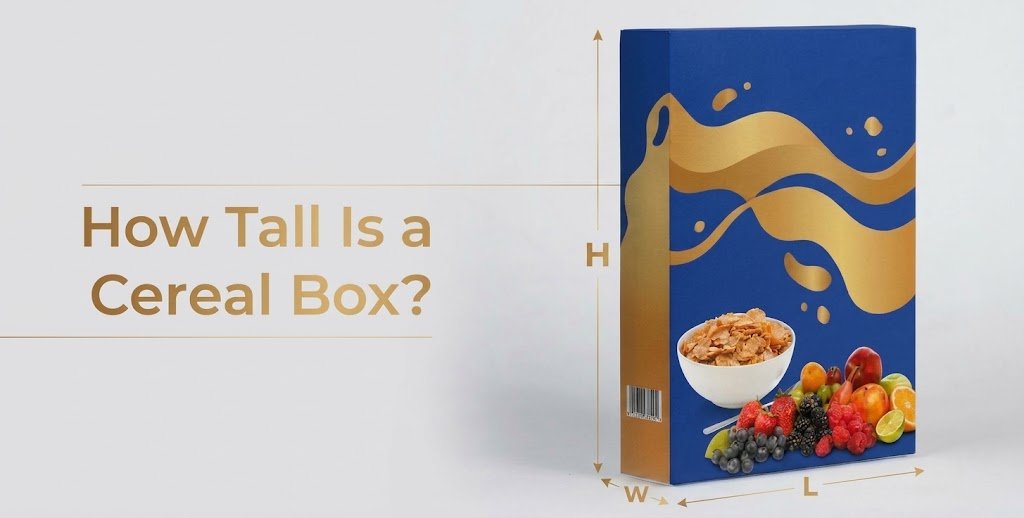
There’s a practical reason for this. Grocery shelves are set at fairly standard heights, and a box around 12 inches tall fits upright with enough room above it for staff to slide it in and shoppers to pull it out. A tall box also gives the brand a large front panel, almost like a small billboard, for the logo, product name and artwork.
The height changes more noticeably once you move outside the standard size:
- Mini boxes are about 5.5 to 6.5 inches (14 to 16.5 cm) tall.
- Family-size boxes usually run 12.5 to 15 inches (31.8 to 38.1 cm) tall.
- Giant and club packs can reach 14 to 16 inches (35.6 to 40.6 cm).
Also Read: How Much Is a Quarter of Weed?
What Is the Average Size of a Cereal Box?
The average size of a cereal box is close to the standard size: about 12 × 8 × 2 to 2.5 inches (30.5 × 20.3 × 5.1 to 6.4 cm). If you need one reference number for planning or a mockup, 12 × 8 × 2.5 inches is a safe starting point.
Width and depth vary more from brand to brand than height does. Width usually sits between 7.5 and 8 inches. Depth is the measurement brands adjust most, anywhere from 1.75 inches for dense cereals to 2.5 inches for lighter, puffier ones.
Standard Cereal Box Size
The standard, or regular, cereal box is the one you see most often on store shelves. Its typical dimensions are:
- Height: 11.5–12 in (29.2–30.5 cm)
- Width: 7.5–8 in (19.1–20.3 cm)
- Depth: 1.75–2.5 in (4.4–6.4 cm)
- Typical contents: about 10–18 oz
This size balances several needs at once. It holds enough cereal for a household, fits standard shelving, stacks neatly in shipping cartons, and leaves room on the side and back panels for the nutrition facts, ingredient list and barcode.
Mini Cereal Box Dimensions
Mini cereal boxes, also called single-serve boxes, hold one portion. You’ll see them in hotel breakfasts, school cafeterias, airline meals, variety packs and product samples. Typical mini cereal box dimensions are:
- Height: 5.5–6.5 in (14–16.5 cm)
- Width: 3.5–4 in (8.9–10.2 cm)
- Depth: 1.25–1.5 in (3.2–3.8 cm)
- Typical contents: about 1–1.5 oz
Because they’re small, mini boxes are usually sold in multipacks or shipped in bulk cartons rather than placed on the shelf one at a time.
Small Cereal Box Size
Between the mini box and the standard box sits the small retail box. It’s common for specialty cereals, organic brands, premium granolas and trial sizes. A small cereal box usually measures:
- Height: 10–11 in (25.4–27.9 cm)
- Width: 7–7.5 in (17.8–19.1 cm)
- Depth: 1.75–2 in (4.4–5.1 cm)
- Typical contents: about 7–10 oz
It maintains the familiar shape of a traditional box while reducing packaging costs and the amount of material used per unit. For businesses looking for a more sustainable alternative, molded pulp packaging is another option worth considering, especially for products that need protective, eco-friendly packaging.
Family Size Cereal Box Dimensions
A family-size box holds noticeably more cereal than a standard box. Brands usually grow all three measurements a little rather than just one. Typical family size cereal box dimensions are:
- Height: 12.5–15 in (31.8–38.1 cm)
- Width: 8–10 in (20.3–25.4 cm)
- Depth: 2.5–3 in (6.4–7.6 cm)
- Typical contents: about 18–24 oz
You’ll see a fairly wide height range here because “family size” is a marketing label, not a fixed specification. One brand’s family box may be only slightly taller than its regular box, while another’s is close to 15 inches.
Giant and Club Pack Sizes
Above family size, some brands sell “giant,” “mega” or “value” boxes, and warehouse stores carry club packs. These often hold two inner bags instead of one. They typically measure:
- Height: 14–16 in (35.6–40.6 cm)
- Width: 9–12 in (22.9–30.5 cm)
- Depth: 3–4.5 in (7.6–11.4 cm)
- Typical contents: 24 oz and up
Why Do Cereal Box Sizes Vary?
Even within the “standard” category, no two brands use exactly the same box. A few factors explain the differences:
- Cereal density. Heavy, compact cereals like granola, muesli and bran need less space per ounce, so they can use a thinner box. Light, puffed or flaked cereals take up more room for the same weight and need a deeper box.
- Net weight. Brands decide how many ounces they want to sell at a given price, then size the box around that amount.
- Shelf fit. Boxes are designed to fit standard store shelving, which is why height stays fairly steady while width and depth change.
- Filling equipment. Cereal is packed on automated lines built around specific carton sizes. Changing a box’s dimensions often means adjusting or retooling that equipment, so brands tend to keep their sizes stable.
- Shipping and storage. Box size affects how many units fit in a shipping case and on a pallet. A small change in depth can change how efficiently a whole truckload is packed.
- Promotions and product changes. Bonus-size offers, special editions and in-box prizes can lead to temporary size changes. When brands reduce the amount of cereal in a box, they often shave off depth while keeping the front panel the same, so the box looks unchanged on the shelf.
This is why the same “regular” box can measure 11.5 inches tall at one brand and 12 inches at another, or 2 inches deep for one cereal and 2.5 inches for the next.
How to Measure Cereal Box Dimensions
Measuring a cereal box takes a few minutes with a ruler or tape measure. For the most accurate result:
- Stand the box upright on a flat surface with the front panel facing you.
- Measure the height from the bottom edge to the top edge.
- Measure the width across the front panel from left to right.
- Measure the depth across the side panel, from front to back.
- Write the numbers down in the same order every time, such as height × width × depth, and label each one.
- Round to the nearest 1/16 inch or millimeter if the measurements will be used for packaging or printing.
External vs. Internal Dimensions
There are two ways to measure a box, and they give slightly different results:
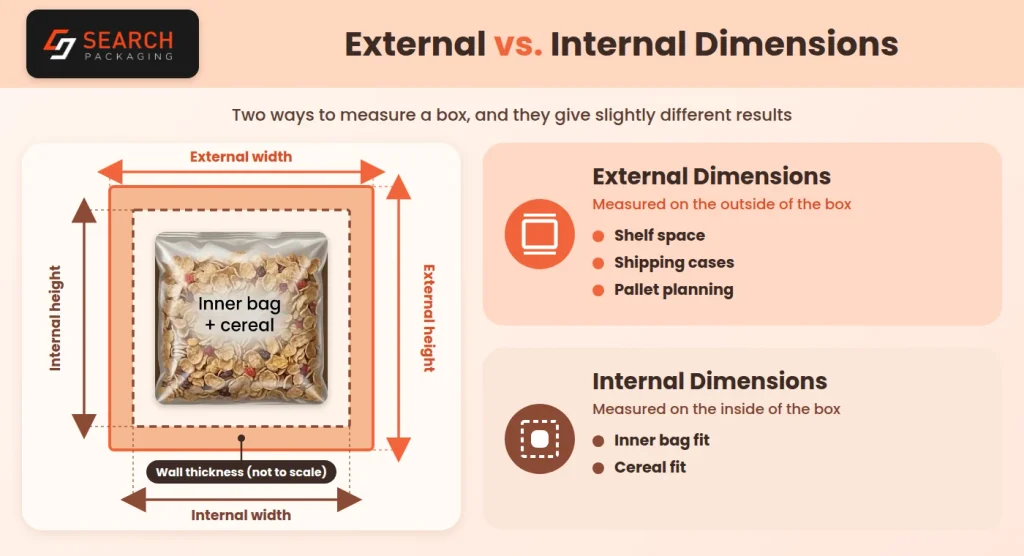
- External dimensions are measured on the outside of the box. These matter for shelf space, shipping cases and pallet planning.
- Internal dimensions are measured on the inside. These matter for making sure the inner bag and cereal fit properly.
The difference comes from the thickness of the paperboard walls. It’s small, often a fraction of an inch, but it adds up when you’re ordering thousands of boxes. If you’re sending specs to a packaging supplier, tell them which type of measurement you’re providing.
How to Find the Volume of a Cereal Box
Once you have the three measurements, finding the volume is simple:
Volume = height × width × depth
For a standard box measuring 12 × 8 × 2.5 inches:
12 × 8 × 2.5 = 240 cubic inches (about 3,933 cm³)
For a thinner box measuring 12 × 8 × 1.75 inches:
12 × 8 × 1.75 = 168 cubic inches (about 2,753 cm³)
This comparison shows how much depth matters. Dropping the depth by just 0.75 inch removes 72 cubic inches, or 30% of the space, while the front of the box looks exactly the same.
What Are Cereal Boxes Made Of?
Most cereal boxes are made from folding paperboard, a stiff, single-layer board that is easy to print on, folds cleanly on packing machines, and is light enough to keep shipping costs down. It differs from the brown corrugated cardboard used for shipping boxes. Corrugated board is typically used for larger cases that hold multiple cereal boxes, often designed as shelf-ready packaging to make stocking shelves easier for retailers.
The three paperboard types you’ll see most often are:
- Clay-coated recycled board (CRB). This is the most common choice for cereal. It’s made from recycled fiber, has a smooth white coated surface for printing, and is usually gray on the inside. If you tear open a cereal box and see a gray interior, it’s almost certainly a recycled board.
- Solid bleached sulfate (SBS). This is a bright white board made from virgin fiber, white on both sides. It gives sharper print quality and is often used for premium or specialty products.
- Kraft or unbleached board. This is a natural brown board with a raw, earthy look. It’s popular with organic and natural brands that want the packaging to match that image.
The Inner Liner
The paperboard box is not airtight or moisture-proof. Its job is to give the package structure, protect the cereal from crushing and carry the branding. Keeping the cereal fresh is the job of the inner liner, the sealed bag inside the box.
Most liners today are made from plastic film, such as high-density polyethylene. Older boxes used wax-coated paper, and some brands are now testing recyclable or compostable liners. Since the liner sits inside the box, its size has to work with the box’s internal dimensions, not the external ones.
How Thick Is a Cereal Box?
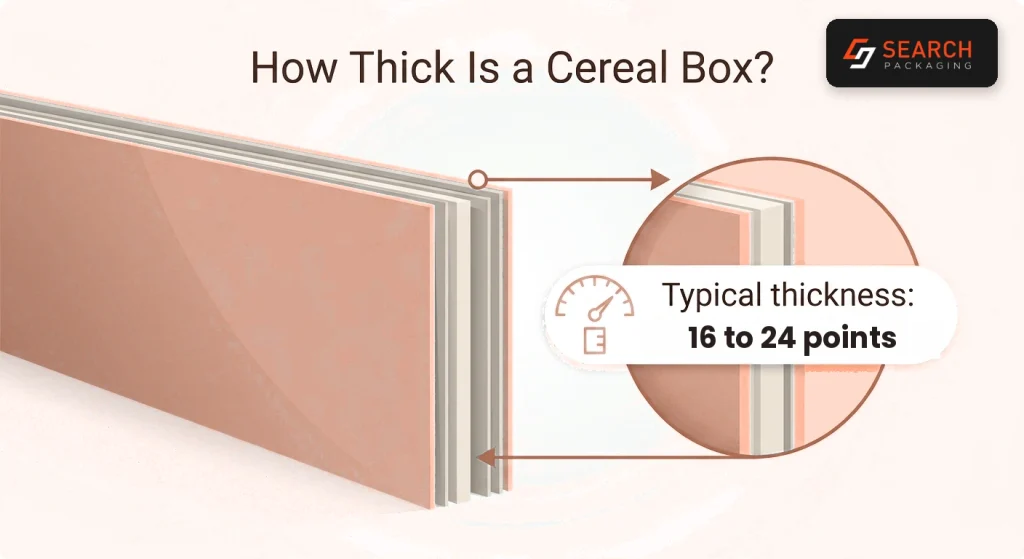
Cereal box paperboard is usually between 16 and 24 points thick. In packaging, one point (pt) equals one-thousandth of an inch, so the conversion is straightforward:
| Board Thickness | Inches | Millimeters |
| 16 pt | 0.016 in | 0.41 mm |
| 18 pt | 0.018 in | 0.46 mm |
| 20 pt | 0.020 in | 0.51 mm |
| 22 pt | 0.022 in | 0.56 mm |
| 24 pt | 0.024 in | 0.61 mm |
Smaller and lighter boxes, such as minis, can use the thinner end of this range. Larger family and club packs, which carry more weight and get stacked higher in warehouses, generally need thicker boards so the bottom boxes don’t crush or bulge.
Cereal Box Dieline and Template Size
A dieline is the flat layout of a box before it’s cut, folded and glued. It shows where every panel, flap and fold line sits, and it’s the file printers use to line up the artwork with the structure.
A typical cereal box dieline includes:
- The front and back panels, sized to the box’s height and width
- Two side panels, sized to the box’s height and depth
- A glue flap along one edge, which joins the panels into a tube
- Top and bottom closure flaps, which fold and seal the ends
- Bleed, extra artwork past the cut line, commonly 1/8 inch (about 3 mm), so no white edges show after cutting
Also Read: Tissue Box Dimensions
How Big Is a Cereal Box Template?
Because the box is unfolded, the flat template is much larger than the finished box. You can estimate the width of the flat sheet by adding up the four panels and the glue flap:
Flat width = (box width + box depth) × 2 + glue flap
For a standard 12 × 8 × 2.5 inch box:
(8 + 2.5) × 2 = 21 inches, plus a glue flap that is usually around 0.5 to 0.75 inch wide.
The flat height is the box height plus the top and bottom closure flaps. Flap size depends on the closure style, so this number varies more. For production, always use the exact dieline from your packaging supplier rather than a homemade template. Even a small error in a fold line can make a box that won’t close or won’t run on a filling machine.
How to Choose Custom Cereal Box Dimensions
If you’re designing a box for your own product, the standard sizes in this guide are a useful starting point, but the right size comes from your cereal, not from a chart. A few practical steps help you get it right:
If you’re designing a box for your own product, the standard sizes in this guide are a useful starting point, but the right size depends on your cereal, not just a chart. A few practical steps can help you get it right while keeping packaging costs under control:
- Start with the net weight. Decide how many ounces or grams you want each box to hold.
- Fill-test with your real product. Pour the measured amount of cereal into a liner bag and see how much space it actually takes. A light, puffed cereal and a dense granola at the same weight need very different boxes.
- Allow for settling. Cereal settles during shipping and handling, so a box that looks full at the factory will look less full when it’s opened. Some headspace is normal and expected.
- Check shelf and case fit. Make sure the height suits standard retail shelving, and work out how many boxes fit in a shipping case and on a pallet.
- Match the liner to the inside. Size the inner bag to the box’s internal dimensions so it fits without bunching or tearing.
- Choose board thickness for the weight. Heavier fills and taller boxes need stiffer boards to hold their shape when stacked.
Conclusion
Cereal box dimensions aren’t fixed by law or by any single industry rule, but most brands stay remarkably close to the same few sizes. A standard cereal box is about 12 inches tall, 7.5 to 8 inches wide and 1.75 to 2.5 inches deep (around 30.5 × 19–20.3 × 4.4–6.4 cm). Mini boxes are roughly half that height, and family-size and club packs grow in all three directions to hold more cereal.
Height tends to stay steady because of shelf space, while depth is the measurement brands adjust most to fit their cereal’s density and net weight. Whether you’re comparing boxes, planning shelf space or designing your own packaging, exploring Search Packaging for packaging insights, along with knowing these ranges and how to measure a box correctly, gives you a reliable place to start.
Frequently Asked Questions
What are the dimensions of a standard cereal box?
A standard cereal box is about 12 inches tall, 7.5 to 8 inches wide and 1.75 to 2.5 inches deep. In metric, that’s roughly 30.5 cm tall, 19 to 20.3 cm wide and 4.4 to 6.4 cm deep. Exact sizes vary slightly by brand and product.
How many inches is a cereal box?
Most regular cereal boxes are about 12 inches tall and 8 inches wide, with a depth of 2 to 2.5 inches. A common reference size is 12 × 8 × 2.5 inches.
What are cereal box dimensions in cm?
A standard cereal box measures about 30.5 cm tall, 19 to 20.3 cm wide and 4.4 to 6.4 cm deep. A mini box is about 14 to 16.5 cm tall, and a family-size box is about 31.8 to 38.1 cm tall.
What size is a family-size cereal box?
A family-size cereal box usually measures 12.5 to 15 inches tall, 8 to 10 inches wide and 2.5 to 3 inches deep, and typically holds about 18 to 24 ounces of cereal. Because “family size” is a marketing term, sizes vary more between brands than they do for standard boxes.
What are mini cereal box dimensions?
Mini or single-serve cereal boxes are typically 5.5 to 6.5 inches tall, 3.5 to 4 inches wide and 1.25 to 1.5 inches deep. They usually hold about 1 to 1.5 ounces, which is one serving.
Are cereal box sizes standardized?
No. There’s no law that sets the physical size of a cereal box. In the US, the FDA requires an accurate net weight on the label and prohibits misleading empty space in packaging, known as nonfunctional slack-fill. The common sizes you see come from industry practice, shelf space and packing equipment, not from regulation.
How do you measure a cereal box?
Stand the box upright and measure the height from bottom to top, the width across the front panel, and the depth across the side panel from front to back. Write the measurements in a consistent order, such as height × width × depth, and note whether you measured the outside or the inside of the box.
Why isn’t a cereal box filled to the top?
Cereal settles during shipping and handling, so some empty space at the top is normal. Filling machines also need a little headroom to fill and seal the inner bag properly. This kind of functional space is allowed. Large amounts of empty space with no practical purpose are not.
How thick is the cardboard on a cereal box?
Cereal boxes are made from paperboard that is usually 16 to 24 points thick, which is 0.016 to 0.024 inches (about 0.41 to 0.61 mm). Larger, heavier boxes generally use thicker boards.