

Shoe box dimensions vary depending on the shoe size, footwear style, and packaging design. A commonly used reference size for an adult shoe box is approximately 13 × 7.5 × 4.5 inches (33.02 × 19.05 × 11.43 cm). However, this is not a universal standard. Boxes for children’s shoes are usually smaller, while large sneakers, high heels, and boots may need more space.
Choosing the right shoe box size helps protect footwear, prevents unnecessary packaging waste, and makes storage and shipping easier. Whether you are measuring an existing box or planning packaging for a new shoe collection, understanding length, width, and height is the first step.
This guide covers standard shoe box dimensions, size comparisons for men, women, and children, and the measurements that matter when selecting a suitable box.
What Are the Standard Shoe Box Dimensions?
A typical adult shoe box measures around 13 inches long, 7.5 inches wide, and 4.5 inches high. These measurements are a useful starting point for ordinary footwear, but actual box sizes differ between manufacturers and shoe styles.
There is no single standard shoe box size that fits every pair of shoes. A box for flat sandals may be much shallower than one designed for high-top sneakers or boots.
The following measurements show a common adult reference size:
| Measurement | Inches | Centimeters | Millimeters |
| Length | 13 | 33.02 | 330.2 |
| Width | 7.5 | 19.05 | 190.5 |
| Height | 4.5 | 11.43 | 114.3 |
These figures describe an example box measuring 13 × 7.5 × 4.5 inches, not a required industry specification. These measurements are practical reference sizes rather than fixed industry standards. Differences occur because manufacturers consider shoe size, footwear shape, packing arrangement, and box construction when determining dimensions.
When selecting packaging, always compare the box’s internal dimensions with the space needed for the actual pair of shoes.
Shoe Box Size Chart: Inches, CM, and MM
Shoe box dimensions are commonly written as length × width × height (L × W × H). The chart below provides practical reference sizes for different footwear categories.
| Shoe box category | Dimensions in inches (L × W × H) | Dimensions in cm (L × W × H) | Dimensions in mm (L × W × H) |
| Children’s shoe box | 8 × 5 × 3 | 20.32 × 12.70 × 7.62 | 203.2 × 127 × 76.2 |
| Women’s shoe box | 12 × 7 × 4 | 30.48 × 17.78 × 10.16 | 304.8 × 177.8 × 101.6 |
| Average adult shoe box | 13 × 7.5 × 4.5 | 33.02 × 19.05 × 11.43 | 330.2 × 190.5 × 114.3 |
| Men’s shoe box | 14 × 8 × 5 | 35.56 × 20.32 × 12.70 | 355.6 × 203.2 × 127 |
Note: These are illustrative reference dimensions, not universal standards or verified specifications for a particular brand. All metric values are calculated directly from the inch measurements.
The actual dimensions may be larger or smaller depending on the footwear. For example, a bulky running shoe may need a wider box than a slim dress shoe, even when both are sold in the same shoe size.
Why Do Shoe Box Dimensions Matter?
Correct shoe box measurements help protect shoes and make packaging more practical.
A box that is too small may press against the toe, heel, or upper part of the shoe. An oversized box may allow the footwear to move during handling unless suitable inserts or cushioning are used.
The right dimensions also help with:
- Product protection: Provide enough space without squeezing or bending the shoes.
- Shipping efficiency: Avoid unnecessary package volume that may affect shipping charges.
- Storage: Make boxes easier to arrange on shelves and in cartons.
- Packaging materials: Reduce unnecessary empty space and excess filler.
- Presentation: Keep the footwear properly positioned when the box is opened.
For footwear businesses, accurate dimensions are especially important when ordering packaging in large quantities. Measuring a finished sample before production can prevent fitting problems later.
Men’s Shoe Box Dimensions
A common reference size for a men’s shoe box is approximately 14 × 8 × 5 inches (35.56 × 20.32 × 12.70 cm). However, men’s shoe boxes vary according to shoe size, shape, and style.
Larger shoe sizes generally require more length, while bulky athletic shoes may need additional width or height.
Typical Men’s Shoe Box Size Range
For general planning, the following ranges appear in packaging size guides:
| Measurement | Reference range in inches |
| Length | 13–15 inches |
| Width | 7–10 inches |
| Height | 4–6 inches |
These ranges are broad examples rather than guaranteed dimensions for every men’s shoe box.
A low-profile dress shoe may fit in a relatively shallow box. Running shoes with thick soles and high-top sneakers may need taller packaging.
Important: Men’s footwear size alone does not determine the exact box dimensions. Two shoes marked with the same size can have different shapes and require different packaging.
Women’s Shoe Box Dimensions
A common reference size for a women’s shoe box is 12 × 7 × 4 inches (30.48 × 17.78 × 10.16 cm). Actual dimensions depend on the shoe style and how the pair is arranged inside the box.
Women’s footwear includes flats, sandals, sneakers, pumps, and boots. These styles do not all need the same amount of space.
Typical Women’s Shoe Box Size Range
| Measurement | Reference range in inches |
| Length | 11–13 inches |
| Width | 7–8 inches |
| Height | 4–5 inches |
These figures provide a starting point for ordinary footwear, but they should not be treated as fixed specifications.
For example, flat shoes may need less height than high heels. Some heels require extra clearance to protect the heel structure, while ankle boots may need a taller box.
When choosing women’s shoe packaging, measure the shoes in their intended packing position instead of relying only on a general size chart.
Also Read: Shelf ready packaging
Kids’ Shoe Box Dimensions
A common reference size for a children’s shoe box is 8 × 5 × 3 inches (20.32 × 12.70 × 7.62 cm). However, children’s shoe boxes vary considerably because footwear sizes change across age groups.
A box for toddler shoes will usually be smaller than one designed for older children’s sneakers.
Typical Kids’ Shoe Box Size Range
| Measurement | Reference range in inches |
| Length | 6–10 inches |
| Width | 5–6 inches |
| Height | 2–4 inches |
These are general packaging references, not a universal sizing system.
Children’s sandals may fit in shallow boxes, while sports shoes or winter boots can require more height and width.
For an accurate fit, measure the actual pair and account for any tissue paper, inserts, or other protective materials.
Men’s vs. Women’s vs. Kids’ Shoe Box Dimensions
The main difference between men’s, women’s, and children’s shoe box sizes is the amount of space required for the footwear.
| Feature | Men’s shoe boxes | Women’s shoe boxes | Kids’ shoe boxes |
| Example size | 14 × 8 × 5 in | 12 × 7 × 4 in | 8 × 5 × 3 in |
| Typical size relationship | Often larger | Often medium-sized | Usually smaller |
| Main size consideration | Shoe length and bulk | Style and heel height | Age and footwear size |
| Common variation | Dress shoes vs. sneakers | Flats vs. heels or boots | Toddler shoes vs. older kids’ shoes |
The examples above are useful for comparison, but the categories overlap. Some women’s boots may need larger boxes than men’s dress shoes, and older children’s sneakers may require packaging close to adult sizes.
The most reliable approach is to choose the box based on the footwear’s actual dimensions, not only the men’s, women’s, or kids’ lael.
Shoe Box Dimensions for Different Types of Shoes
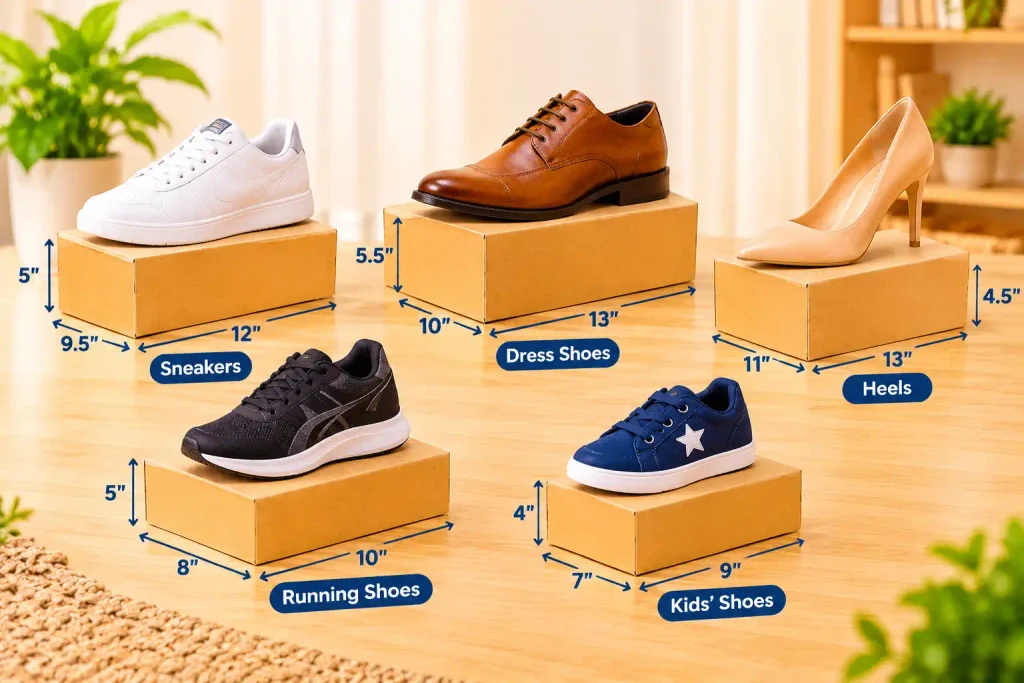
Shoe box dimensions also depend on footwear style. Sneakers, high heels, boots, sandals, and dress shoes have different shapes, so they may need different amounts of space.
Sneaker Box Dimensions
Sneaker boxes generally need enough length for the shoes and sufficient width and height for their soles and uppers. A 14 × 8 × 5-inch box is one possible reference size for adult sneakers, but it will not fit every model.
Chunky sneakers and high-top designs may require more room than low-profile casual shoes. Measure the pair in its intended packing position before choosing the box.
High-Heel Shoe Box Dimensions
High-heel shoe boxes often need additional height to protect the heels and prevent pressure on the shoe’s upper.
There is no universal box size for high heels because heel heights and shoe shapes vary. Pumps, stilettos, and platform heels may require different packaging.
The box should allow the shoes to rest securely without bending the heels or pressing against the lid.
Boot Box Dimensions
Boot boxes are usually taller or larger than ordinary shoe boxes, particularly for ankle boots, hiking boots, and knee-high boots.
The required dimensions depend on the shaft height, sole thickness, and whether the boots can be safely placed on their sides.
Tall boots should not be forced into shallow boxes, as this may crease or damage their uppers.
Dress Shoe Box Dimensions
Dress shoes often fit in relatively shallow boxes, although pointed toes and larger sizes may require extra length.
For men’s dress shoes, a box around 14 × 8 × 5 inches can serve as an initial reference, but the actual fit must be checked.
Tissue paper or shoe supports may also need space inside the box to help maintain the footwear’s shape.
Sandal and Flat Shoe Box Dimensions
Sandals and flat shoes generally require less height than boots or bulky sneakers. Their box length and width still depend on the footwear size and design. Some sandals have thick soles or decorative straps that require additional clearance. A shallow box can reduce unnecessary packaging space when the shoes fit comfortably.
How to Measure Shoe Box Dimensions Correctly
To measure a shoe box, record its length, width, and height (L × W × H) using a ruler or measuring tape. Measure the inside when checking product fit and the outside when calculating storage or shipping space.
Follow these steps:
- Measure the Length: Record the longest horizontal side of the box.
- Measure the Width: Measure the shorter horizontal side.
- Measure the Height: Measure the vertical distance from the bottom to the top.
- Check Internal Dimensions: Measure the usable space inside the box to confirm the shoes will fit.
- Check External Dimensions: Measure the complete closed box for shipping, shelving, or storage.
For example, a box measuring 13 inches long, 8 inches wide, and 5 inches high is written as 13 × 8 × 5 inches (L × W × H).
Always state whether the measurements are internal or external, especially when ordering custom shoe packaging.
Internal vs. External Shoe Box Dimensions
Internal dimensions measure the usable space inside a shoe box, while external dimensions measure its overall outside size.
The difference comes from the packaging material, folds, and box construction.
| Measurement | What It Includes | Main Purpose |
| Internal dimensions | Usable space inside the box | Checking shoe fit |
| External dimensions | Complete outside of the box | Shipping and storage |
| Material thickness | Thickness of the box walls | Packaging design and strength |
Real Example: USPS Priority Mail Shoe Box
The USPS Priority Mail Shoe Box provides a useful example of how internal and external dimensions differ.
| Measurement | Dimensions (L × W × H) |
| External dimensions | 14⅞ × 5¼ × 7⅜ inches |
| Internal dimensions | 14⅜ × 5⅛ × 7¼ inches |
These are published measurements for this specific USPS shipping box, not standard dimensions for all retail shoe boxes.
The internal space is smaller because the box walls occupy part of its overall size. When selecting packaging, use internal measurements to check product fit and external measurements for shipping calculations.
Shoe Box Dimensions for Shipping
Shoe box dimensions for shipping depend on the size of the footwear, the protective packaging, and the shipping carrier’s requirements.
A 14 × 8 × 5-inch box is one possible reference for an adult pair of shoes, but there is no universal shipping box size suitable for every pair.
Shipping shoes safely requires enough room for the footwear and any protective materials without leaving excessive empty space.
How Shoe Box Size Affects Shipping Costs
Shipping carriers may calculate charges using both actual package weight and dimensional weight.
Dimensional weight reflects the space a package occupies, rather than only how heavy it is.
For example, FedEx uses the following formula for dimensional weight in pounds for applicable services:
Dimensional weight = Length × Width × Height (inches) ÷ 139
Consider a shipping box measuring 14 × 8 × 5 inches:
- Package volume: 560 cubic inches
- Calculated dimensional weight: approximately 4.03 lb
This is a calculation example, not a shipping quote. Billing rules, rounding, and dimensional-weight thresholds vary by carrier and service.
Using a box much larger than necessary may increase shipping and custom packaging costs, even if the shoes themselves are lightweight.
What Size Shipping Box Do You Need for Shoes?
The shipping box should accommodate the complete footwear package, including protective cushioning where needed. For ordinary shoes, measure the retail shoe box first if it will be placed inside an additional shipping carton.
For boots, high-top sneakers, or delicate heels, allow sufficient room for protection without creating excessive empty space. Before shipping, confirm the carrier’s current size limits and measurement requirements.
How Much Does a Shoe Box Weigh?
The weight of an empty shoe box depends on its dimensions, material, board thickness, and construction. A lightweight folding paperboard box will generally weigh less than a similarly sized box made with heavier corrugated board or rigid materials.
There is no reliable universal weight for every shoe box. For accurate shipping calculations, weigh the actual empty box and then weigh the complete packed shipment. Do not confuse the weight of an empty shoe box with the weight of a box containing shoes.
Shoe Box Materials and Thickness
Shoe boxes are commonly made from paperboard, corrugated cardboard, or rigid board. Each material has different properties that affect strength, weight, and the space available inside the box.
| Material | Main Characteristics | Common Use |
| Folding paperboard | Lightweight and easy to fold | Retail shoe boxes |
| Corrugated cardboard | Fluted structure provides cushioning and strength | Shipping and protective packaging |
| Rigid board | Thick, sturdy construction | Premium footwear packaging |
| Kraft-based paperboard | Paper-based material available in different grades | Retail and custom packaging |
How Does Cardboard Thickness Affect Shoe Box Dimensions?
Thicker packaging walls reduce the internal space available when the external dimensions remain unchanged. For example, two boxes with identical external measurements may have different usable interior dimensions if they use different materials or constructions.
Material thickness also affects box weight and structural performance. The correct board grade should be selected according to the weight of the shoes, handling conditions, and required protection rather than assuming that one thickness suits every box.
Shoe Box Dimensions for Storage
For storage, the most important measurements are the external length, width, and height of the closed shoe box. These measurements determine how many boxes can fit on shelves, inside cabinets, or in warehouse storage areas. Boxes with consistent dimensions are generally easier to arrange and stack. However, the box must also be strong enough to support the intended stacking load.
How to Calculate Shoe Box Volume
Box volume can be calculated by multiplying length, width, and height.
Volume = Length × Width × Height
For example, a box measuring 13 × 8 × 5 inches has a rectangular external volume of:
13 × 8 × 5 = 520 cubic inches
This calculation is useful when comparing storage space or estimating package volume. It does not mean the box provides 520 cubic inches of usable interior space, because the walls and construction take up some room.
Shoe Box Volume Calculator
Use the shoe box volume calculator below to find the total volume of your box. Enter its length, width, and height, then select your preferred measurement unit to get the result in cubic inches and cubic centimeters.
Shoe Box Volume Calculator
Enter your shoe box dimensions to calculate its total volume.
Volume: —
Cubic Inches: —
Cubic Centimeters: —
Formula: Length × Width × Height. This gives the box’s geometric volume, not its exact usable interior capacity.
Why Consistent Box Sizes Matter
Consistent shoe box dimensions can simplify storage planning, shelf organization, and packing operations. However, using one identical box for every footwear style is not always practical. Large boots may need taller packaging, while flat shoes may fit in shallower boxes. The goal is to use as few box sizes as practical while still providing a proper fit for each footwear category.
International Shoe Box Shipping Considerations
International shipments require attention to package dimensions, weight, protective materials, and destination-specific carrier requirements.
Before shipping footwear internationally, check:
- Package dimensions: Confirm the carrier’s maximum length, size, and girth limits.
- Dimensional weight: Check whether the shipment is billed according to its volume or actual weight.
- Packaging strength: Select materials suitable for the expected handling conditions.
- Destination requirements: Review applicable customs documentation and packaging restrictions.
- Protective space: Keep shoes secure without unnecessarily increasing package size.
There is no universal international shoe box size. The suitable dimensions depend on the footwear and the shipping service.
How to Choose the Right Shoe Box Size
The right shoe box size should fit the footwear comfortably without leaving excessive empty space. Choose dimensions based on the actual shoes, their packing position, and any protective materials.
Follow these five steps:
- Measure the Shoes: Check the length, width, and height of the complete pair.
- Consider the Shoe Type: Allow suitable clearance for thick soles, high heels, or tall uppers.
- Check Internal Dimensions: Make sure both shoes fit without bending or compression.
- Allow Space for Protection: Include enough room for tissue paper, inserts, or cushioning where needed.
- Test the Box: Place the shoes inside and close the lid to confirm a comfortable fit.
For custom shoe boxes, testing a physical sample before ordering in bulk helps identify fitting problems.
Do Shoe Box Dimensions Vary by Brand?
Yes. Shoe box dimensions vary between brands and may also differ across models, footwear sizes, and product collections from the same manufacturer.
Brands such as Nike, Adidas, Puma, and Reebok use different packaging designs for different types of footwear. A box for running shoes may not have the same dimensions as one used for casual sneakers or boots.
There is no single verified shoe box measurement that applies to every product from these brands. When replacing an original box or preparing packaging for a specific shoe model, measure the existing box or obtain the manufacturer’s product-specific dimensions.
Common Shoe Box Measurement Mistakes to Avoid
Incorrect measurements can lead to poor-fitting packaging, wasted space, and shipping problems.
- Using One Size for Every Shoe: Different footwear styles need different box dimensions.
- Confusing Internal and External Sizes: Use inside measurements for shoe fit and outside measurements for shipping.
- Ignoring Shoe Height: Allow enough space for heels, high-tops, and boots.
- Forgetting Packaging Materials: Account for inserts, tissue paper, and protective cushioning.
- Choosing Oversized Boxes: Avoid unnecessary empty space that increases package volume.
- Skipping a Fit Test: Check the actual shoes inside a sample box before placing a bulk order.
Practical Tips for Accurate Shoe Box Sizing
A few simple checks can help you select more suitable packaging.
- Measure the Complete Pair: Check how both shoes fit together, not just one shoe.
- Decide the Packing Position: Arrange the shoes as they will appear inside the finished box.
- Check the Lid Clearance: Make sure the lid closes without pressing against the footwear.
- Use Consistent Units: Record all dimensions in the same unit and follow the L × W × H order.
- Confirm the Box Specifications: Ask whether the supplier’s measurements refer to internal or external dimensions.
- Keep a Size Record: Save approved box measurements for future packaging orders.
Conclusion
Understanding shoe box dimensions helps you choose packaging that fits properly, protects footwear, and uses storage and shipping space efficiently.
Although an adult shoe box measuring approximately 13 × 7.5 × 4.5 inches is a useful reference, there is no universal size for every pair of shoes. Men’s, women’s, and children’s footwear, along with sneakers, heels, and boots, may require different dimensions.
For accurate results, measure the footwear, check the box’s internal space, and test the fit before finalizing the packaging. You can find more practical packaging guides on Search Packaging.
Frequently Asked Questions About Shoe Box Dimensions
1. What are the standard shoe box dimensions?
A commonly used adult shoe box reference is approximately 13 × 7.5 × 4.5 inches. Actual dimensions vary by footwear size, style, and manufacturer.
2. What is the average shoe box size in centimeters?
A box measuring 13 × 7.5 × 4.5 inches is equivalent to 33.02 × 19.05 × 11.43 cm. This is a reference size, not a universal standard.
3. Are all shoe boxes the same size?
No. Shoe boxes differ according to shoe size, footwear type, brand, and packaging design.
4. What are typical men’s shoe box dimensions?
A common reference size is 14 × 8 × 5 inches (35.56 × 20.32 × 12.70 cm). Larger or bulkier shoes may require more space.
5. What are typical women’s shoe box dimensions?
A common reference size is 12 × 7 × 4 inches (30.48 × 17.78 × 10.16 cm). High heels and boots may need taller boxes.
6. What are typical kids’ shoe box dimensions?
A reference size for children’s shoes is 8 × 5 × 3 inches (20.32 × 12.70 × 7.62 cm). Sizes vary considerably between toddler and older children’s footwear.
7. How do you measure a shoe box correctly?
Measure the length, width, and height, then record them as L × W × H. Use internal dimensions for shoe fit and external dimensions for shipping or storage.
8. What size box do I need for sneakers?
The box must accommodate the sneaker’s length, width, and height without compressing the shoes. A 14 × 8 × 5-inch box may be a starting reference for some adult sneakers, but actual measurements determine the correct fit.
9. What is the difference between internal and external shoe box dimensions?
Internal dimensions describe the usable space inside the box. External dimensions include the box walls and represent its overall outside size.
10. Do shoe box dimensions affect shipping costs?
Yes. Some shipping services use dimensional weight when calculating charges. Larger packages can cost more even when their actual weight is relatively low.
11. What are Nike and Adidas shoe box dimensions?
Nike and Adidas do not use one universal box size for every shoe. Dimensions depend on the model, footwear size, and packaging design. Measure the specific box for an accurate answer.
12. Can shoe boxes be made in custom sizes?
Yes. Custom shoe boxes can be manufactured in dimensions suited to particular footwear, provided the chosen material and box construction support the design.